

HomeWaterIQ is reader-supported. When you buy through links on this page, we may earn a commission at no extra cost to you. As an Amazon Associate, we earn from qualifying purchases.
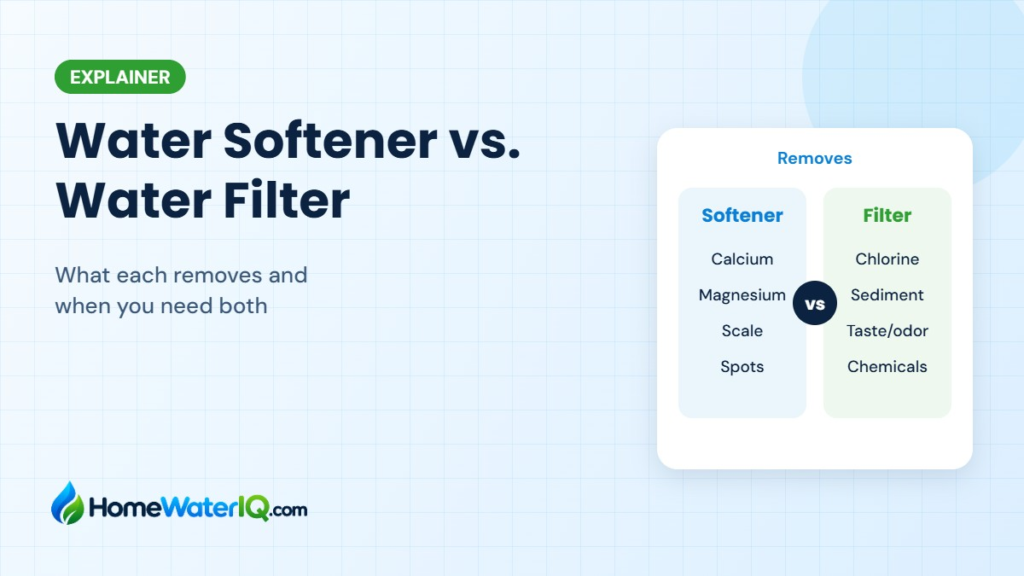
Short answer: a water softener fixes hard water. It swaps out calcium and magnesium so you get less scale, fewer spots and better soap lather. A water filter fixes what’s in the water: chlorine or chloramine taste and smell, sediment, and, with the right certified filter, contaminants like lead, VOCs or PFAS. A softener doesn’t make water safer to drink, and most filters don’t soften. Many homes with hard water need both: a filter first, then the softener, plus a reverse osmosis system for drinking water.
This guide explains what each one removes, the signs that point to each, and how city and well water change the answer. It’s based on EPA, USGS and NSF guidance and manufacturer specs, not hands-on testing.
Softener vs. filter at a glance
| Water softener | Water filter | |
|---|---|---|
| Main job | Removes hardness (calcium, magnesium) | Reduces chlorine, chloramine, sediment, chemicals |
| How it works | Ion exchange: resin trades hardness minerals for sodium or potassium | Carbon, KDF, sediment media or membranes trap or adsorb contaminants |
| Fixes | Scale, spots, dry skin, poor lather | Taste, odor, cloudiness, specific health contaminants |
| Makes water safer to drink? | No | Only if certified for that contaminant |
| Ongoing upkeep | Salt refills, occasional cleaning | Cartridge or media changes |
| Key certification | NSF/ANSI 44 | NSF/ANSI 42 (taste, odor), 53 (health), 401, 58 (RO) |
What a water softener removes
Hard water is water high in dissolved calcium and magnesium. The USGS classifies water at 0 to 60 mg/L (as calcium carbonate) as soft, 61 to 120 as moderately hard, 121 to 180 as hard, and over 180 as very hard. Those minerals aren’t a health risk, but they leave scale in water heaters, faucets and appliances.
A salt-based softener runs water through resin beads that grab the calcium and magnesium and release sodium (or potassium, if you use potassium salt). When the resin is full, it “regenerates” by flushing with brine from the salt tank. Softeners are built for hardness. They’re not designed to remove chlorine, PFAS, lead or bacteria, so don’t expect them to.
What a water filter removes
“Water filter” covers many products. A whole-house carbon filter mainly removes chlorine taste and smell. Catalytic carbon handles chloramine better, which matters because more than one in five Americans drink chloramine-treated water, according to the EPA. Sediment filters catch sand, rust and grit. KDF media targets some metals and chlorine.
For health contaminants, the certification tells you what a filter actually does. NSF/ANSI 42 covers taste and odor. NSF/ANSI 53 covers health claims like lead, VOCs and PFOA/PFOS. NSF/ANSI 58 covers reverse osmosis systems, which remove the widest range of dissolved contaminants at a single tap. A label like NSF/ANSI 61 or 372 only means the parts are safe for drinking water, not that the filter removes anything.
Signs you need a softener, a filter or both
Signs of hard water (softener):
- White crust on faucets, showerheads and in the kettle
- Spots on glasses and shower doors
- Soap and shampoo that won’t lather well
- Water heater or dishwasher scale problems
Signs you need a filter:
- Pool-like chlorine smell or taste
- Cloudy water, grit or sand in aerators
- Rotten-egg smell, or orange or black stains (common on wells)
- Your water report or a lab test shows lead, PFAS, nitrate or other contaminants
Many of these “signs” are easy to misread, so test. A cheap hardness test strip tells you if you need a softener. For contaminants, use your water report or a certified lab.
City water vs. well water
City water. Your utility must send an annual Consumer Confidence Report (CCR), and most post it online. It lists the disinfectant (chlorine or chloramine), detected contaminants and, often, hardness. City water is treated and monitored, so the usual upgrades are a carbon filter for taste and smell and a softener if the water is hard.
PFAS is the big new question. In April 2024 the EPA set limits of 4 parts per trillion for PFOA and PFOS. In May 2026 it proposed keeping those two limits while dropping limits for four other PFAS and letting some utilities have until 2031 to comply. If your CCR shows PFAS, a certified RO system for drinking water is the most cost-effective fix.
Well water. No one tests a private well but you. Get a lab test before you buy anything. Wells often need sediment filtration and a softener, and may also need iron or manganese removal or UV treatment for bacteria (look for NSF/ANSI 55). Iron can foul softener resin, so heavy iron usually needs its own filter.
When you need both, and in what order
If you have hard water and chlorine, sediment or other issues, you need both. The usual order where water enters the house is:
- 1. Sediment pre-filter to protect everything after it from grit
- 2. Whole-house carbon filter to remove chlorine or chloramine, which can wear down softener resin over time
- 3. Water softener for hardness
- 4. Reverse osmosis at the kitchen sink for drinking and cooking water
On wells, iron filters and UV fit into this chain too, so follow your installer’s or manufacturer’s layout. The RO step is worth it with a softener. It removes the extra sodium that softening adds, along with most dissolved contaminants. See our best reverse osmosis systems.
What about salt-free “softeners”?
Salt-free conditioners, often using template-assisted crystallization (TAC), change hardness minerals into tiny crystals that are less likely to stick as scale. They don’t remove calcium or magnesium, so your water still tests hard. You won’t get the slick soft-water feel or fully spot-free glass.
They make sense if you mainly want less scale and can’t or don’t want to use salt or a drain line. Results vary with hardness and water chemistry, so check the maker’s hardness limits before you buy. Some whole-house filter brands sell them as add-ons, like the salt-free conditioner Aquasana offers with its Rhino filter.
Costs at a high level
Whole-house filters range widely. Three-stage cartridge systems like the iSpring WGB32B cost around $500 with about $130 a year in filters, while long-life tank systems like the Pelican PC600 or Aquasana Rhino run about $1,000 and go 5 to 10 years between media changes. PFAS-certified whole-house systems cost $2,000 or more. Compare them in our best whole house water filters guide.
Softener prices depend on size, brand and whether a dealer installs it, and salt is an ongoing cost. See our water softener cost guide and best water softeners, and use the water softener size calculator so you don’t overbuy. Under-sink RO is usually the cheapest piece of the puzzle.
Decision table: which do you need?
| Your situation | What to get |
|---|---|
| Scale and spots, water tastes fine | Softener (or salt-free conditioner for scale only) |
| Chlorine taste or smell, no scale | Whole-house carbon filter |
| City water with chloramine | Catalytic carbon or “chloramine” filter |
| Hard water plus chlorine taste | Carbon filter, then softener |
| PFAS, lead or nitrate in your report or test | Certified RO (NSF/ANSI 58) or NSF/ANSI 53 filter for drinking water |
| Softened water, want better drinking water | Add under-sink RO |
| Well water | Lab test first; usually sediment filter plus softener, maybe iron filter or UV |
| Renting or no room for a tank | Under-sink filter or RO, shower filter |
FAQ
Can a water softener replace a water filter?
No. A softener is designed to remove hardness minerals. It won’t take out chlorine taste, PFAS or most other contaminants. If you want cleaner-tasting or safer water, you need a filter or RO system as well.
Should the filter go before or after the softener?
Usually before. A sediment filter comes first to catch grit, then a carbon filter to remove chlorine, then the softener. That keeps sediment and chlorine away from the softener resin. An RO system for drinking water goes last, at the sink.
Is softened water safe to drink?
For most people, yes, but softening adds sodium. If you’re on a low-sodium diet, ask your doctor, use potassium chloride instead of salt, or drink from an RO tap, which removes most of the added sodium.
How do I know if my water is hard?
Check your utility’s water report or use a test strip. By USGS classes, 121 to 180 mg/L is hard and over 180 is very hard. Many softener makers use grains per gallon; divide mg/L by about 17.1 to convert.
Do salt-free water softeners work?
They can reduce scale buildup, but they don’t soften water. Hardness stays in the water, so you won’t get the soft-water feel. They’re a fair choice if scale is your main problem and salt isn’t an option.
Related guides
- Signs of hard water
- How to test water hardness
- How a water softener works
- Best salt-free water softeners
- Water hardness converter
Sources: USGS, water hardness classifications; EPA, chloramines in drinking water; EPA, Consumer Confidence Reports; Jones Day, EPA’s May 2026 PFAS proposal; Waste Dive, EPA PFAS proposal; NSF, PFAS and filtration standards; Aquasana, Rhino Max Flow; Tractor Supply, iSpring WGB32B; Pentair, PC600.
Keep reading
 The Best Water Filters for Home in 2026: The Right Type and Top Pick for Your Water
The best water filter is the one that matches your water problem. Start with the right type, then get our…
 Signs of Hard Water: 10 Clues in Your Home (and What the Science Says)
White crust on faucets, spotty glasses and soap that won't lather are classic signs of hard water. Here's how to…
 Clearly Filtered Review (2026): Pitcher, Bottle and Under-Sink
Clearly Filtered claims to reduce 386+ contaminants, including fluoride, but only chlorine, taste and odor are certified. Here's what you…