

HomeWaterIQ is reader-supported. When you buy through links on this page, we may earn a commission at no extra cost to you. As an Amazon Associate, we earn from qualifying purchases.
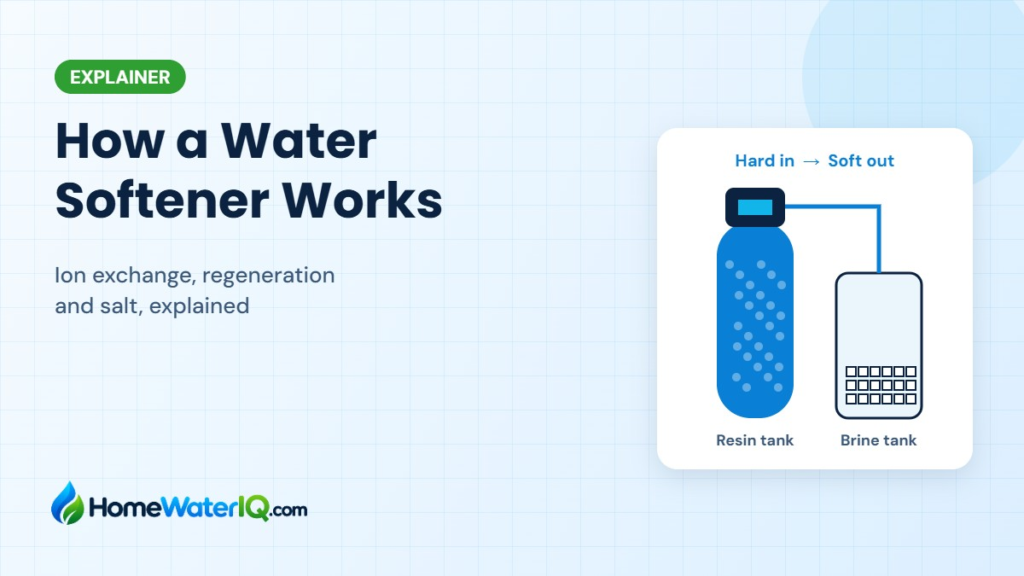
Short answer: a water softener runs your water through a tank of resin beads that grab calcium and magnesium (the minerals that make water hard) and release sodium or potassium in their place. When the beads are full of hardness, the softener “regenerates”: it flushes the resin with salty brine from a second tank, which knocks the hardness loose and sends it down the drain. A typical home-center softener costs about $580 to $930, and salt runs about $50 to $150 a year.
This guide explains the process in plain terms, using manufacturer manuals, EPA’s WaterSense guidance and university extension publications. We haven’t tested softeners ourselves; where we give numbers, we cite where they come from.
What hard water is
Hard water carries dissolved calcium and magnesium picked up from rock and soil. It’s measured in milligrams per liter (mg/L, the same as ppm) or grains per gallon (gpg). One gpg equals 17.1 mg/L, and our water hardness converter switches between them. EPA’s WaterSense guide calls water hard above 120 mg/L (7 gpg) and says softeners are often recommended above 180 mg/L (about 10.5 gpg).
Hardness leaves scale in pipes, water heaters and fixtures, spots on dishes and a soap film in the shower. See the signs of hard water, or learn how to test water hardness before you buy anything.
Ion exchange: the core idea
Inside the main tank is a bed of small plastic resin beads. Each bead is covered with negatively charged sites that hold positively charged ions. When the softener is ready, those sites hold sodium (or potassium, if you use potassium chloride).
Calcium and magnesium ions carry a stronger charge than sodium, and the resin holds them more tightly. So as hard water flows through, the beads grab calcium and magnesium and let sodium go. EPA calls this cation exchange. The water leaves with the hardness swapped out for sodium, which doesn’t form scale.
Softeners also exchange small amounts of other positive ions, including dissolved (clear-water) iron and manganese. Iron builds up on the resin over time, though, which is why well owners need to plan for it. See our best water softener for well water guide.
The three main parts
| Part | What it is | What it does |
|---|---|---|
| Resin (mineral) tank | Tall fiberglass tank, often about 10 x 54 inches for a 48,000-grain unit | Holds the resin beads that soften the water |
| Control valve | The head on top of the resin tank | Measures water use or tracks time, starts regeneration and routes water through each step |
| Brine tank | Shorter plastic tank next to it | Holds salt and water that dissolve into brine for regeneration |
The control valve is the brain. Home-center units such as Whirlpool and Morton use their own valves. Online kits and many dealer systems use standard valves such as the Fleck 5600SXT, which any water-treatment shop can repair.
The regeneration cycle, step by step
Resin can only hold so much hardness. When it’s close to full, the control valve takes the tank offline and runs a cleaning cycle. Most softeners do this in the middle of the night; the University of Nebraska says automatic units typically regenerate between midnight and 4 a.m. Here are the usual steps on a standard downflow softener:
| Step | What happens | Typical length |
|---|---|---|
| 1. Backwash | Water flows up through the resin bed, lifting and loosening the beads and flushing sediment and debris to the drain. | About 10 minutes, or until the drain runs clear |
| 2. Brine draw | The valve pulls salty brine from the brine tank through a small injector and slowly down through the resin. Sodium pushes the calcium and magnesium off the beads. | Usually the longest step |
| 3. Slow rinse | Once the brine is drawn, water keeps flowing slowly through the bed, pushing the remaining brine and freed hardness to the drain. | Often combined with brine draw; the two together commonly run about an hour |
| 4. Fast rinse | Water flows quickly down through the bed to rinse out leftover salt and repack the resin for service. | About 5 to 10 minutes |
| 5. Brine refill | Fresh water flows back into the brine tank to dissolve salt for the next cycle. | A few minutes; some valves refill first instead |
Put together, a regeneration usually takes about 1 to 3 hours. The University of Nebraska says 60 to 120 minutes are generally needed for brine to pass through and flush the tank, and Water Filter Guru puts the full cycle at about 2 to 3 hours. During that time a single-tank softener sends unsoftened water to the house (or, on some valves, none at all), which is why regeneration is scheduled for overnight.
Each cycle uses water. EPA says a typical softener uses 20 to 70 gallons per regeneration, and some larger systems up to 200.
Metered vs. timer regeneration
How the valve decides when to regenerate matters more for running costs than almost anything else.
- Timer (time-initiated): regenerates on a fixed schedule, such as every three days, whether you used much water or not. EPA’s WaterSense guide says to avoid these.
- Metered (demand-initiated): a water meter counts gallons. You program your hardness, the valve calculates how many gallons the resin can soften, and it regenerates only when that’s used up. Some units sense hardness instead of counting gallons.
Metered valves usually keep a small reserve so you don’t run out of soft water before the overnight cycle. Many also have a “day override” that forces a regeneration after a set number of days even if you’ve been away, which keeps the resin fresh.
Single tank vs. twin tank
Most home softeners have one resin tank. They work well, but you get hard water during regeneration. Twin-tank softeners have two resin tanks and switch between them, so one softens while the other regenerates. That means soft water around the clock and no need to wait until 2 a.m.
The best-known twin-tank brand is Kinetico, sold through dealers. Its softeners run on water pressure with a mechanical meter, so they need no electricity. See our Kinetico water softener review for how that design works and what it costs.
Capacity and salt efficiency
Softeners are rated in grains: how much hardness the resin removes before it needs regenerating. A 32,000-grain softener removes 32,000 grains per cycle. If your home uses 300 gallons a day at 15 gpg, that’s 4,500 grains a day, so the 32,000-grain unit lasts about 7 days. Our water softener size calculator does the math.
The headline number comes with a catch: capacity depends on how much salt you use per regeneration, and the relationship isn’t linear. Morton’s MSD45E manual shows it clearly. The same softener is rated at 13,233 grains with 2.6 pounds of salt and 45,400 grains with 17.2 pounds. That’s about 5,089 grains per pound of salt at the low setting and roughly 2,640 at the high one. Smaller salt doses regenerate more often but waste far less salt.
That’s why NSF/ANSI 44 matters. Softeners certified to it with an efficiency rating must regenerate on demand, remove at least 3,350 grains of hardness per pound of salt, and use no more than 5 gallons of water per 1,000 grains removed. Check our best water softeners for certified models.
How much sodium does softened water add?
North Dakota State University and the University of Nebraska both put it at about 8 mg/L of sodium for each grain per gallon of hardness removed. So water at 15 gpg picks up roughly 120 mg of sodium per liter. If you drink 2 liters a day, that’s about 240 mg, around a tenth of the FDA’s 2,300 mg Daily Value for sodium. Very hard water adds more.
If you’re on a sodium-restricted diet, NDSU says to talk with your doctor. Your options are potassium chloride instead of salt (it costs more and works a bit less efficiently), leaving the kitchen cold tap unsoftened, or adding a reverse osmosis system at the kitchen sink, which removes most of the added sodium.
What a water softener doesn’t do
A softener is not a filter. The University of Nebraska lists bacteria, hydrogen sulfide, silt and sand, lead, nitrate and pesticides among the things softeners don’t remove. They also don’t remove chlorine, chloramine or PFAS. If you want cleaner water as well as softer water, you need a filter too. Our water softener vs. water filter guide explains how to combine them.
How salt-free “softeners” differ
Salt-free systems don’t use ion exchange. Most use template-assisted crystallization (TAC), which turns calcium and magnesium into tiny crystals that are less likely to stick as scale. The minerals stay in the water, so a hardness test reads about the same and you won’t get the slick feel or better lather of softened water. EPA describes them as conditioners that don’t remove hardness ions. They use no salt and send no water to a drain, which helps where softener discharge is restricted. Compare options in our best salt-free water softeners.
Maintenance
- Salt: EPA says to use pellets made for softeners (not rock, road or table salt), keep the brine tank about half full, check it every 4 to 6 weeks and don’t let it drop below a quarter full. Don’t fill it to the top, which can cause salt bridging. See our best water softener salt picks.
- Resin cleaning: EPA recommends cleaning the resin once a year. A cleaner such as Res-Up goes into the brine well before a manual regeneration. Homes with clear-water iron need it more often; Morton says at least every six months.
- Brine tank: EPA suggests cleaning it every few years to remove sludge.
- Resin life: Water Filter Guru puts resin life at about 8 to 15 years. Chlorine in city water shortens it, and so does iron. Water that no longer feels soft or more frequent regenerations are common signs.
What a water softener costs to own
Home-center softeners cost about $580 to $930, online kits and direct-sold systems about $800 to $1,750, and dealer-installed systems often $1,800 or more. Salt runs about $50 to $150 a year for most homes, plus regeneration water and a few dollars of electricity. Resin replacement is about $300 if you do it yourself. Our water softener cost guide has the full breakdown, and the water softener cost calculator estimates your yearly salt and water bill from your hardness and household size.
FAQ
How does a water softener work in simple terms?
Resin beads inside the tank trade sodium for the calcium and magnesium in your water. When the beads are full of hardness, the softener rinses them with salt brine to reload them with sodium and flushes the hardness down the drain.
How often should a water softener regenerate?
It depends on hardness, water use and capacity. Many homes size for a regeneration every 4 to 7 days. A metered softener figures this out on its own from the gallons you use.
Do water softeners use electricity?
Most do, for the control valve, but only a few dollars’ worth a year. Some twin-tank designs, such as Kinetico’s, run entirely on water pressure and need no outlet.
Is softened water safe to drink?
For most people, yes. It adds about 8 mg/L of sodium per gpg of hardness removed. If you’re on a low-sodium diet, ask your doctor, use potassium chloride, or drink from a reverse osmosis tap.
Why does my water feel slippery after softening?
Without calcium and magnesium, soap lathers fully and rinses off without leaving the sticky film that hard water does. The slick feel is your skin without soap scum, not soap left behind.
Sources: EPA WaterSense, water softener guide (May 2026); University of Nebraska Extension, drinking water treatment: water softening; NDSU Extension, water softening (ion exchange); Pentair, Fleck 5600SXT downflow manual; Pentair, Fleck SXT control manual; Water Filter Guru, regeneration time; Morton, MSD45E manual; PNNL Building America Solution Center, NSF/ANSI 44 efficiency criteria; FDA, sodium in your diet; Water Filter Guru, resin replacement; USGS, water hardness.
Keep reading
 Best Water Softener Salt of 2026: Pellets, Crystals and Potassium Compared
Most softeners run best on high-purity pellets that cost about $8 to $10 a bag. We compared pellets, solar crystals,…
 SpringWell Water Softener Review (2026): Specs, Real Price and Fine Print
SpringWell sells strong-flowing softeners with a lifetime warranty, but no system-level certification. We break down the SS, FutureSoft and combo…
 SpringWell vs. Aquasana: Which Brand Should You Buy?
SpringWell and Aquasana both sell whole-house filters, well systems, softeners and drinking water filters online. We compared them by certifications,…