

HomeWaterIQ is reader-supported. When you buy through links on this page, we may earn a commission at no extra cost to you. As an Amazon Associate, we earn from qualifying purchases.
Short answer: the most reliable signs of hard water are white, chalky scale on faucets, showerheads and kettles; spots and film on dishes and glass shower doors; soap and shampoo that won’t lather; soap scum rings; and stiff, dull laundry. Over time, scale can clog showerheads and cut water heater efficiency. Claims about skin and hair are less clear-cut: hard water is linked to eczema risk in infants, but a major trial found softeners didn’t improve eczema in children. Hard water isn’t a health risk. Confirm it with a quick test (strips cost about $10) before you buy a softener.
This guide is based on USGS, WHO and state health department guidance plus published studies, not our own testing. Where the evidence comes from industry-funded research, we say so.
Signs of hard water at a glance
| Sign | Where you’ll see it | How strong a clue |
|---|---|---|
| White, chalky crust (scale) | Faucets, showerheads, kettles, coffee makers | Strong |
| Spots and cloudy film | Glasses, dishes, shower doors, car after washing | Strong |
| Soap won’t lather | Shower, hand washing, laundry | Strong |
| Soap scum rings | Tubs, sinks, shower walls | Strong |
| Stiff, dingy laundry | Towels, whites, dark colors | Moderate |
| Weak shower spray | Clogged showerhead nozzles, aerators | Moderate |
| Noisy or slow water heater | Popping or rumbling tank, longer heat-up | Moderate |
| Short appliance life | Dishwashers, coffee makers, tankless heaters | Moderate |
| Dry skin, “squeaky” feel | After showering | Weak (many causes) |
| Dull or tangled hair | After washing | Weak (mixed evidence) |
What hard water is
Hard water carries dissolved calcium and magnesium picked up from limestone, chalk and other rock. The USGS calls water hard at 121 to 180 mg/L (about 7 to 10.5 grains per gallon) and very hard above 180 mg/L. You’ll see hardness written in mg/L, ppm or gpg; our water hardness converter switches between them.
When hard water is heated or evaporates, those minerals come out as scale, mostly calcium carbonate. When it meets soap, they form an insoluble curd: soap scum. Almost every sign below comes from one of those two reactions.
Signs in the kitchen and bathroom
1. White, chalky scale
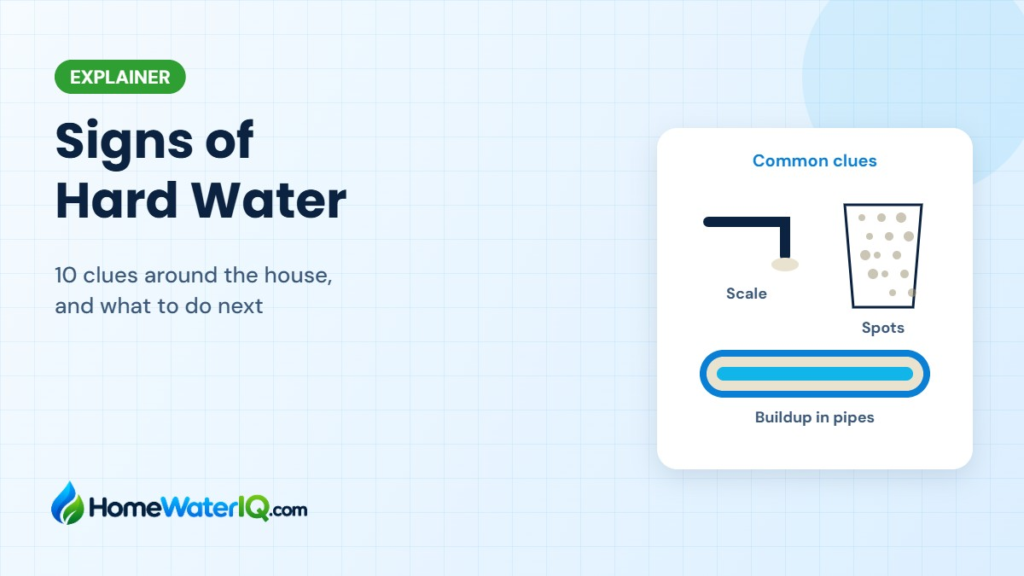
The classic sign is a white or off-white crust around faucet bases, on showerhead nozzles and inside kettles and coffee makers. It’s hard and gritty, and it dissolves in vinegar. Heat speeds it up, which is why kettles and hot-water fixtures scale first.
2. Spots and film on dishes and glass
When droplets dry, the minerals stay behind. Glasses come out of the dishwasher cloudy or spotted, glass shower doors develop a haze, and your car gets white spots if you wash it with hose water and let it air-dry.
3. Soap that won’t lather, and soap scum
Hardness was originally defined by how much soap water uses up. The WHO describes hard water as needing “considerably more soap” to lather, and the USGS notes very hard water raises soap and detergent use. You’ll see thin lather in the shower, a gray ring in the tub, and a film on shower walls that ordinary cleaners struggle with.
4. Stiff, dingy laundry
Minerals bind with detergent, so less of it goes to cleaning. Towels can feel scratchy, whites turn gray over time, and darks fade or look dull. Modern detergents include water softening agents that help, but in very hard water many people find they need more detergent to get the same result.
Signs in your plumbing and appliances
5. Weak shower spray and clogged aerators
Scale builds in the tiny nozzles of showerheads and in faucet aerators, so spray gets uneven or weak. If pressure is fine at a hose bib but poor at one showerhead, scale is a likely culprit. Low pressure across the whole house usually has other causes, like a failing pressure regulator or old galvanized pipe, so don’t blame hardness alone.
The best-known data come from a study by Battelle, funded by the Water Quality Research Foundation (the research arm of the softener industry’s trade group, the Water Quality Association). In accelerated testing, low-flow showerheads on hard water clogged after an average of about 3,200 gallons, while those on softened water kept working. Hard-water low-flow faucets clogged after the equivalent of 19 days of use. Keep the industry funding in mind, but the mechanism is well understood.
6. A noisy or slower water heater
Scale settles at the bottom of tank water heaters and coats heating elements. You may hear popping or rumbling as water trapped under the scale boils, and the heater may take longer to recover. Draining a tank and finding white flakes or gravel-like chunks is a strong sign.
In the same Battelle study, gas storage heaters on hard water built up about 528 grams of scale a year versus 7 grams on softened water. Softened-water heaters kept their factory efficiency, and reporting on the study cites efficiency losses of up to 48% for storage heaters on hard water. Tankless heaters run at 26 gpg had scale plug their outlet plumbing after the equivalent of 1.6 years. Those are lab results with very hard water, so your losses will likely be smaller at moderate hardness.
7. Appliances that wear out early
Dishwashers, coffee makers, humidifiers and washing machines all collect scale. In the Battelle tests, dishwashers and clothes washers run on hard water for 30 days showed noticeable scale buildup, while softened-water units cleaned up with a quick wipe. The Minnesota Department of Health also lists longer appliance life as a benefit of softening.
Signs on your skin and hair: what the evidence says
This is where marketing gets ahead of the science, so here’s the honest version.
8. Dry, itchy skin
Many people say their skin feels tight or “squeaky” in hard water, likely because soap residue is harder to rinse off. There’s some research behind a link to eczema. A 2016 King’s College London study of about 1,300 three-month-old babies in the UK found that living in a hard-water area was linked to up to an 87% higher risk of eczema. The authors stressed that this is an association, not proof that hard water causes it.
The key test of whether a softener helps came earlier. The Softened Water Eczema Trial (SWET), published in PLOS Medicine in 2011, randomly gave 336 children with moderate to severe eczema either a water softener or usual care for 12 weeks. Softened water brought no measurable extra benefit; both groups improved by similar amounts on objective measures. Some parents still felt the softener helped. If someone in your home has eczema, talk to a doctor rather than counting on a softener.
9. Dull, tangled or brittle hair
Mineral residue can leave hair feeling coated and harder to rinse clean. The research is thin and mixed. Small lab studies in the International Journal of Trichology have disagreed: a 2013 study found no significant change in hair strength after soaking in hard water, while a 2018 study of hair from 70 men found hard water lowered tensile strength. Neither shows that hard water causes hair loss.
10. Taste, and is hard water bad for your health?
Very hard water can taste slightly chalky or bitter. The WHO puts the taste threshold for calcium at about 100 to 300 mg/L, depending on what it’s paired with, and notes that many people accept higher levels.
Hard water isn’t a health risk. The USGS says calcium and magnesium aren’t toxic and the EPA has set no limit for hardness. The WHO proposes no health-based guideline value for hardness either. Calcium and magnesium are essential nutrients, though food is the main source for most people. Softening does have a health trade-off to know about: it adds sodium. We cover how much in our guide to the best water softener salt.
Signs that point to something other than hardness
- Orange or reddish-brown stains: iron, common in well water.
- Black or dark brown stains: often manganese.
- Blue-green stains: usually corrosive water eating copper pipes. That’s the opposite of hard water, and a reason to test for copper and lead.
- Rotten-egg smell: hydrogen sulfide or bacteria, not hardness.
- Chlorine or “pool” smell: disinfectant from your utility. A carbon filter fixes it; a softener doesn’t.
If you see these, a softener alone won’t solve it. Start with our water softener vs. water filter guide, and well owners should see the best water filters for well water.
Confirm it with a test
Signs tell you to look; a test tells you the number. City water customers can usually find hardness in the utility’s annual water quality report. To check at home, test strips cost about $10 for 150 and give a rough reading, while a titration drop kit like the Hach 5-B reads to 1 grain per gallon. Well owners should use a certified lab. Our step-by-step guide on how to test water hardness walks through each method.
Check hardness test strips on Amazon
As a rough guide, under about 3.5 gpg is soft, 3.5 to 7 is moderately hard, and above 7 gpg is where most people notice real scale. The Minnesota Department of Health says softening may be needed above 7 gpg (120 mg/L).
How to fix hard water
Salt-based water softener (the proven fix)
An ion exchange softener removes calcium and magnesium for the whole house, which is what stops scale, spots and soap scum. It’s the only option here that actually lowers hardness. A home-center unit costs roughly $580 to $930, plus salt. Size it with our water softener size calculator, compare models in our best water softeners guide, and estimate running costs with the water softener cost calculator. Our how a water softener works explainer covers the basics.
Salt-free conditioner
Template-assisted crystallization (TAC) systems change hardness minerals into tiny crystals that are less likely to stick as scale. They don’t remove hardness, so you’ll still see spots and weaker lather, but they need no salt, no drain and little upkeep. They suit moderate hardness and homes where salt discharge is restricted. See our best salt-free water softeners.
Point-of-use fixes
If only one spot bothers you, treat just that spot. A reverse osmosis system removes hardness from drinking water and stops kettle scale, though hard water will wear its membrane faster. Shower filters mostly target chlorine and don’t soften water, so check claims carefully in our best shower filters guide. Regular descaling with vinegar or citric acid keeps kettles, coffee makers and showerheads working.
FAQ
How can I tell if I have hard water without a test?
Look for white crust on faucets and in kettles, spotty glasses, poor soap lather and soap scum rings. A shake test with pure liquid soap in a bottle of tap water gives a rough hint: few suds and cloudy water suggest hardness. To know how hard, you need a test.
Is hard water bad to drink?
No. The USGS says calcium and magnesium aren’t toxic, the EPA has no limit for hardness, and the WHO has set no health-based guideline for it. The issues are scale, cleaning and taste, not safety.
Does hard water cause eczema or dry skin?
Studies link hard water to higher eczema risk in infants, but that’s an association, not proof. In the SWET trial, installing a water softener did not improve eczema in children more than usual care over 12 weeks. Softened water may feel nicer, but it isn’t a proven eczema treatment.
Can hard water lower my water pressure?
It can reduce flow at fixtures by clogging showerhead nozzles and aerators, and over many years it can narrow hot-water lines. If pressure is low everywhere, check your pressure regulator and pipes too, since hardness is rarely the only cause.
What hardness level needs a water softener?
Most people notice problems above about 7 grains per gallon (120 mg/L), the level at which the Minnesota Department of Health says softening may be needed. Between 3.5 and 7 gpg, a softener is optional, and a salt-free conditioner is a lighter-touch choice.
Sources: USGS, water hardness in the United States; WHO, hardness in drinking-water; WHO, Hardness in Drinking-water background document (2009); Minnesota Department of Health, home water softening; WaterWorld, Battelle study results; Water Canada, Battelle water heater findings; News-Medical, SWET trial results; PLOS Medicine, Softened Water Eczema Trial (2011); King’s College London, hard water and infant eczema (2016); International Journal of Trichology, effects of hard water on hair (2013); International Journal of Trichology, hard water and hair strength (2018).
Keep reading
 The Best Water Filters for Home in 2026: The Right Type and Top Pick for Your Water
The best water filter is the one that matches your water problem. Start with the right type, then get our…
 Water Softener vs. Water Filter: Which Do You Need?
A softener removes hardness minerals; a filter removes chlorine, sediment and chemicals. Here's how to tell which one your home…
 Clearly Filtered Review (2026): Pitcher, Bottle and Under-Sink
Clearly Filtered claims to reduce 386+ contaminants, including fluoride, but only chlorine, taste and odor are certified. Here's what you…