

HomeWaterIQ is reader-supported. When you buy through links on this page, we may earn a commission at no extra cost to you. As an Amazon Associate, we earn from qualifying purchases.
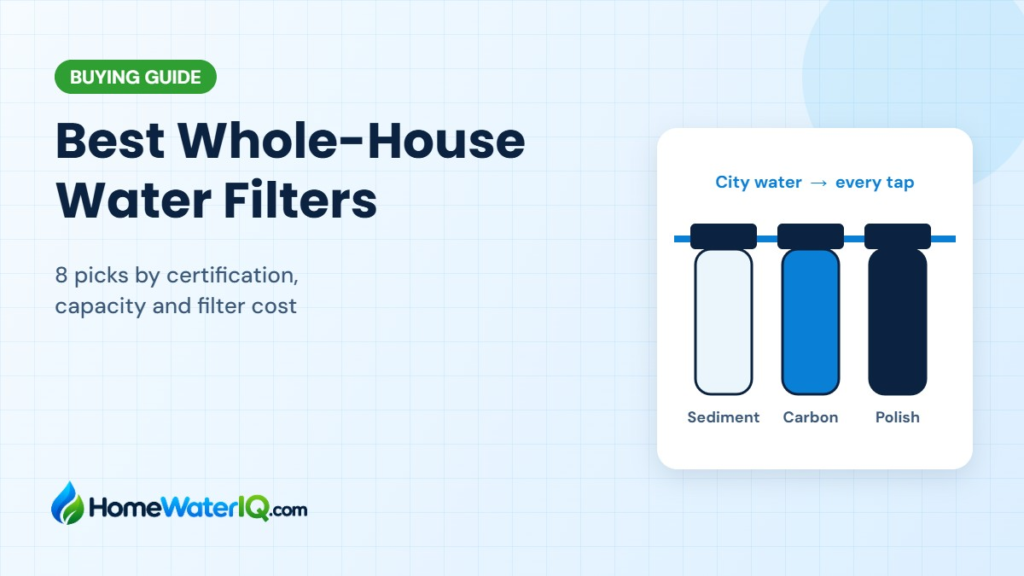
Short answer: the best whole house water filter for most city homes is the Pentair Pelican PC600 (about $1,050): it’s one of the few big carbon-tank systems that is actually certified, not just “tested,” to NSF/ANSI 42 for chlorine reduction, and the media lasts about five years. If you want the longest-lasting tank, the Aquasana Rhino ($999 on sale) is rated for 1,000,000 gallons or 10 years. For PFAS, the Aquasana HealthShield is the rare whole-house system certified to NSF/ANSI 53 and 401. On a budget, the iSpring WGB32B (about $518) is a solid three-stage cartridge system.
We didn’t install these filters or test them ourselves. We picked them by the numbers: which claims are backed by third-party certification, gallons of capacity, flow rate in gallons per minute (gpm), filter life and replacement cost, warranty and price. Prices are U.S. prices from manufacturers and major retailers as of late October 2026 and change often. Not sure if you need a filter or a softener? Start with our water softener vs. water filter guide.
Best whole house water filters at a glance
| Best for | Filter | Capacity | Flow rate | Certification | Price |
|---|---|---|---|---|---|
| Best overall (city water) | Pentair Pelican PC600 | About 650,000 gal / 5 yrs | 10 gpm | IAPMO certified to NSF/ANSI 42 and 61 | About $1,050 |
| Longest tank life | Aquasana Rhino | 1,000,000 gal / 10 yrs | 7 gpm rated, 14.6 peak | Tested to NSF/ANSI 42; tank certified to 61 | $999 (sale) |
| PFAS and VOCs | Aquasana HealthShield | 165,000 gal / about 2 yrs | 5.7 gpm rated, 11.2 peak | WQA certified to NSF/ANSI 53 and 401 | About $2,900 (sale) |
| Budget 3-stage | iSpring WGB32B | 100,000 gal / 12 mo | 15 gpm | “Tested to” NSF/ANSI (standard not named) | About $518 |
| Well water with iron | Home Master HMF3SdgFeC | 100,000 gal carbon | 15 gpm | None stated | About $550 |
| Large homes, high flow | SpringWell CF1 / CF4 / CF+ | 1,000,000 gal | 9 to 20 gpm | Not certified for contaminant reduction | About $1,016 and up |
| Heavy metals (KDF) | Express Water WH300SCKS | 100,000 gal / 6 to 12 mo | About 15 gpm | None stated | About $485 to $548 |
| Quick-change cartridge | 3M Aqua-Pure AP904 | 100,000 gal / about 1 yr | 20 gpm peak | Certified to NSF/ANSI 42 (see notes) | About $426 |
“Certified” vs. “tested to”: read this first
Most whole-house filter ads say “NSF” somewhere. That doesn’t mean much on its own. A product is certified when an accredited body such as NSF, WQA or IAPMO tests it to a standard and lists it in a public database. “Tested to NSF standards” usually means the company paid for a lab test or ran its own, with no ongoing listing. It’s better than nothing, but it’s not the same.
The standard number matters too. NSF/ANSI 42 covers taste and odor, mainly chlorine. NSF/ANSI 53 covers health contaminants such as lead, VOCs and, since NSF folded its old P473 protocol into it, PFOA and PFOS. NSF/ANSI 401 covers “emerging” contaminants like some medications. NSF/ANSI 61 and 372 only mean the parts are safe to touch drinking water and low in lead. They say nothing about what the filter removes.
1. Pentair Pelican PC600: best overall
About $1,050 (FactoryPure listed it at $1,049 but out of stock when we checked). This is a single carbon tank with a 5-micron sediment pre-filter, built for homes with 1 to 3 bathrooms at up to 10 gpm. Pentair says IAPMO R&T certifies it to NSF/ANSI 42 for 97% chlorine reduction and to NSF/ANSI 61 for material safety. That’s a real certification, which most big-tank competitors can’t claim.
Pentair says to replace the carbon media every 5 years or 650,885 gallons, and the sediment pre-filter every 6 to 9 months. Bigger homes can step up to the PC1000, rated for 1,301,770 gallons. One catch: it’s a chlorine filter. If your city uses chloramine, check your water report and consider a catalytic carbon system instead.
Check Pelican PC600 price on Amazon
2. Aquasana Rhino: longest tank life
$999 on sale at Aquasana (MSRP $1,998, and it’s on “sale” most of the time). The main tank is rated for 1,000,000 gallons or 10 years, whichever comes first, at 7 gpm rated and 14.6 gpm peak flow. Aquasana says it is “independently tested to NSF/ANSI Standard 42” to remove up to 97% of chlorine. Note the wording: tested, not certified. The tank itself is WQA certified to NSF/ANSI/CAN 61.
Plan on extra upkeep. The standard pre-filter is a two-month item, and the post-filter is a six-month item (Aquasana offers a longer-life pre-filter upgrade). If your water uses chloramine, get the Rhino Chloramines version, which Aquasana says is tested to NSF/ANSI 42 to remove up to 83% of chloramines. Larger homes can choose the Rhino Max Flow ($1,399 on sale, 14 gpm rated, 10-year limited warranty).
Check Aquasana Rhino price on Amazon
3. Aquasana HealthShield: best for PFAS
About $2,900 on sale as of October 2026 (list price $5,796); replacement tanks are $1,749 on sale, and the warranty is 2 years. This is the pick if PFAS is your main worry. Aquasana says HealthShield is WQA tested and certified to NSF/ANSI 53, 401 and CSA B483.1, with PFAS claims covering PFOA, PFOS, PFNA, PFHxS and PFHpA, plus VOCs. That’s a much stronger claim than “reduces forever chemicals” on a box.
The trade-offs are cost and capacity. The tank is rated for 165,000 gallons, about 2 years, at 5.7 gpm rated and 11.2 gpm peak. Its chlorine and chloramine claims (about 97%) are internally tested, not certified. If you just want PFAS-free drinking water, a certified reverse osmosis system at the kitchen sink costs far less.
4. iSpring WGB32B: best budget pick
About $518 (Tractor Supply’s price in October 2026; Amazon prices vary). The WGB32B uses three big 4.5 x 20-inch cartridges: a 5-micron sediment filter and two carbon blocks. It’s rated for up to 15 gpm and 100,000 gallons, which iSpring calls about a year for a family of four. A three-pack of replacements (F3WGB32B) was $128.99 at Zoro, so yearly costs are low.
Retailers say the carbon filters are “tested by a third party” to meet NSF/ANSI standards, but don’t name the standard, so treat it as uncertified. The warranty is 1 year. iSpring also sells a WGB32BM version with an iron and manganese stage for well water, and a WGB32B-PF version whose media is SGS-tested for PFAS (again, tested, not certified).
Check iSpring WGB32B price on Amazon
5. Home Master HMF3SdgFeC: best for well water with iron
About $550. This three-stage system adds a dedicated iron stage between a multi-gradient sediment filter (25 down to 1 micron) and a carbon filter, with 1-inch ports and up to 15 gpm. Home Master rates it for iron under 3 ppm and manganese under 1 ppm, and the carbon stage for 100,000 gallons.
Replacement filters add up: $35.95 for sediment plus $99.95 each for the iron and carbon filters, or about $236 a set. No contaminant certification is stated, and the warranty is listed as 2 years in one place and “up to 5” in another. If your iron is above 3 ppm, you need a dedicated iron filter, not cartridges.
Sold through Home Master and home-improvement retailers; not currently sold on Amazon.
6. SpringWell CF: best for large homes
About $1,160 for the CF1 (1 to 3 bathrooms, 9 gpm, list price $1,365 as of September 2026), and roughly $1,200 to $1,830 for the CF4 (4 to 6 bathrooms, 12 gpm) and CF+ (7+ bathrooms, 20 gpm) based on recent review coverage; check SpringWell’s site for today’s price. The media is rated for 1,000,000 gallons, and the tanks, valves and housings carry a lifetime warranty with a 6-month money-back guarantee.
The big minus: SpringWell says its parts are NSF-certified, but the system itself isn’t certified for contaminant reduction, including the PFAS it advertises. We include it for flow rate and warranty, not for proven removal. SpringWell is sold mainly direct, so there’s no Amazon link here.
7. Express Water WH300SCKS: best for heavy metals on a budget
$484.79 on sale at Home Depot ($547.99 direct). This three-stage system pairs a sediment filter with a KDF stage (a copper-zinc media aimed at heavy metals and chlorine) and a carbon block. Express Water rates the filter set for 100,000 gallons or 6 to 12 months, at roughly 15 gpm, with a 1-year limited warranty.
Express Water markets it to reduce lead and other heavy metals, but we found no NSF/ANSI 53 certification for that claim. If lead is a real concern (for example, a CCR or home test shows it), use a certified point-of-use filter or RO system for drinking water.
Check Express Water price on Amazon
8. 3M Aqua-Pure AP904: easiest filter changes
About $426 at FreshWater Systems. The AP904 uses a sanitary quick-change cartridge, so you twist out the old one without touching the media. 3M’s literature lists 100,000 gallons (about a year), 20 gpm peak flow, and says the system is “tested and certified to NSF/ANSI standard 42” for the claims on its data sheet, though the chlorine taste and odor claim itself is marked as manufacturer-tested. The system warranty is 1 year.
The downside is cartridge cost. The AP917HD-S replacement ran about $300 to $316 at Discount Filter Store, far more than an iSpring three-pack. You pay for convenience.
Check Aqua-Pure AP904 price on Amazon
Also considered
- Culligan WH-HD200-C ($80 at Home Depot): a heavy-duty filter housing, sold without a cartridge. Its IAPMO certification covers structural integrity only. Good as a cheap sediment pre-filter, not as a full system.
- Waterdrop WHF2E-PC ($165.99): inexpensive, but its “NSF/ANSI 372 Certified” label only means low-lead materials. Filters last about 50,000 gallons or 6 months.
- Aquasana OptimH2O: a cartridge system that Aquasana markets for lead, cysts and PFOA/PFOS reduction to NSF/ANSI 53; we found an IAPMO test record but couldn’t confirm a current certification listing, so check before you buy. Replacement cartridges are $599.99 and last 100,000 gallons or 12 months, so yearly costs are high.
How to choose a whole house water filter
Start with your water report. If you’re on city water, your utility must publish an annual Consumer Confidence Report (CCR). It tells you whether your water is disinfected with chlorine or chloramine and lists detected contaminants. More than one in five Americans drink chloramine-treated water, according to the EPA, and plain carbon handles it poorly. Look for catalytic carbon or a “chloramine” model. On a private well, get a lab test first; iron, manganese, bacteria and hardness change what you need.
Match flow rate to your house. Manufacturers rate 9 to 10 gpm systems, like the SpringWell CF1 and Pelican PC600, for 1 to 3 bathrooms. SpringWell steps up to 12 gpm for 4 to 6 bathrooms. If you have a big home or lots of water running at once, choose a higher-flow or “max flow” version.
Do the cost-per-year math. Cartridge systems are cheap to buy but need new filters every 6 to 12 months ($129 to $316 a year in our picks). Tank systems cost more upfront but go 5 to 10 years between media changes, plus small sediment filters.
Know what a filter won’t do. Carbon filters don’t remove hardness. If you see scale and spots, you need a softener too; see our best water softeners, check the water softener cost guide, and size it with our water softener size calculator. Install the filter before the softener.
PFAS needs proof. In April 2024 the EPA set enforceable limits of 4 parts per trillion for PFOA and PFOS. In May 2026 it proposed keeping those two limits while dropping limits for four other PFAS and giving some utilities until 2031 to comply. Either way, if your report shows PFAS, look for NSF/ANSI 53 or 58 certification that names PFOA and PFOS.
FAQ
Is a whole house water filter worth it?
It’s worth it if you want chlorine taste and smell gone from every tap, including showers, or if you have sediment or well-water issues. If your only concern is drinking water, an under-sink filter or RO system is cheaper and often removes more.
Do whole house water filters remove PFAS?
Some claim to, but few are certified for it. Aquasana’s HealthShield is certified to NSF/ANSI 53 and 401 for several PFAS. Many others say “tested” or “reduces PFAS” without a certification. Check the certifier’s listing, not just the box.
Will a whole house filter lower my water pressure?
A properly sized system shouldn’t cause a big drop. Pressure loss comes from an undersized unit or a clogged sediment filter. Pick a gpm rating that fits your home and change the pre-filter on schedule.
How often do you change a whole house water filter?
Cartridge systems like the iSpring WGB32B and Express Water WH300SCKS need new filters about every 6 to 12 months. Tank systems like the Pelican PC600 and Aquasana Rhino need new media every 5 to 10 years, plus a sediment pre-filter every few months.
Does a whole house filter soften water?
No. Filters target chlorine, sediment and chemicals. Hardness minerals pass right through. For hard water you need a softener or a salt-free conditioner; our softener vs. filter guide explains the difference.
Related guides
- SpringWell vs. Aquasana
- Best water filter for well water
- Best under-sink water filters
- Best shower filters
- How to test water hardness
Sources: Pentair, PC600 whole house filter; FactoryPure, Pelican PC600 pricing; Aquasana, certified products; Aquasana, Rhino tank specs; Aquasana, Rhino Max Flow; Aquasana, HealthShield tank; Aquasana, whole house pricing; Tractor Supply, iSpring WGB32B; Zoro, F3WGB32B filters; Home Master HMF3SdgFeC; Water Filter Guru, SpringWell CF review; Express Water, WH300SCKS; Home Depot, WH300SCKS pricing; 3M Aqua-Pure AP900 series literature; FreshWater Systems, AP904; Home Depot, Culligan WH-HD200-C; Waterdrop, WHF2E-PC; NSF, PFAS and filtration standards; EPA, chloramines in drinking water; Jones Day, EPA’s May 2026 PFAS proposal.
Keep reading
 Aquasana Review 2026: What to Buy and What to Skip
Aquasana sells everything from shower filters to whole-house systems, and its certifications range from strong to marketing-only. We sorted the…
 Best Shower Filters of 2026
Shower filters can cut chlorine, but most don't handle chloramine and none soften hard water. We compared six by certification,…
 Clearly Filtered Review (2026): Pitcher, Bottle and Under-Sink
Clearly Filtered claims to reduce 386+ contaminants, including fluoride, but only chlorine, taste and odor are certified. Here's what you…