

HomeWaterIQ is reader-supported. When you buy through links on this page, we may earn a commission at no extra cost to you. As an Amazon Associate, we earn from qualifying purchases.
Short answer: if you’re on city water, start with your utility’s free annual water quality report (the Consumer Confidence Report), which often lists hardness. To check it yourself, use a titration drop kit like the Hach 5-B (about $35 to $55, reads in 1 gpg steps) for an accurate number, or cheap test strips like Varify or JNW Direct (about $9 to $10 for 150 strips) for a quick ballpark. Well owners should get a certified lab test, which checks iron and other problems at the same time. A TDS meter does not measure hardness, and the soap-bottle test only tells you “hard or not.”
This guide is based on guidance from the EPA, USGS and state health departments plus manufacturer specs. We didn’t run these tests side by side ourselves; the kit picks below are chosen by the numbers: range, resolution, number of tests and price.
Water hardness test methods compared
| Method | Cost | Accuracy | Best for |
|---|---|---|---|
| Utility water quality report (CCR) | Free | Good, but an average for the whole system | City water customers |
| Test strips | About $9 to $10 for 150 | Rough (color blocks) | Quick checks, testing a softener’s output |
| Titration drop kit | About $35 to $55 | Good (1 gpg steps on the Hach 5-B) | Sizing and setting a softener |
| Certified lab test | Varies by lab | Best | Private wells, full picture |
| TDS meter | Inexpensive | Doesn’t measure hardness | Checking RO filters, not hardness |
| Soap-bottle test | Free | Yes/no only | A first hint |
Method 1: check your utility’s water quality report (free)
Every community water system has to send customers an annual Consumer Confidence Report (CCR) by July 1, according to the EPA. Many utilities list hardness in it, usually in a table of “secondary” or “additional” parameters, in mg/L or grains per gallon (gpg).
To find yours:
- Look at your water bill for the utility’s name and website. Most post the CCR as a PDF, often under “water quality.”
- If you can’t find it, use the EPA’s “Find Your Consumer Confidence Report” search on the EPA CCR page and look up your utility by state and name.
- Search the PDF for “hardness,” “total hardness” or “calcium carbonate.”
- If hardness isn’t listed, call the utility. Most will tell you the typical range over the phone.
Keep the limits in mind. The report gives a system average or range, and some utilities blend several sources, so your tap can differ by season or neighborhood. It’s a great starting point, but test at home before you size a softener.
Method 2: test strips (fast, cheap, rough)
Hardness strips have a pad that changes color based on calcium and magnesium. You compare the pad to a printed chart. They’re the easiest option, and a 150-strip pack costs about $10.
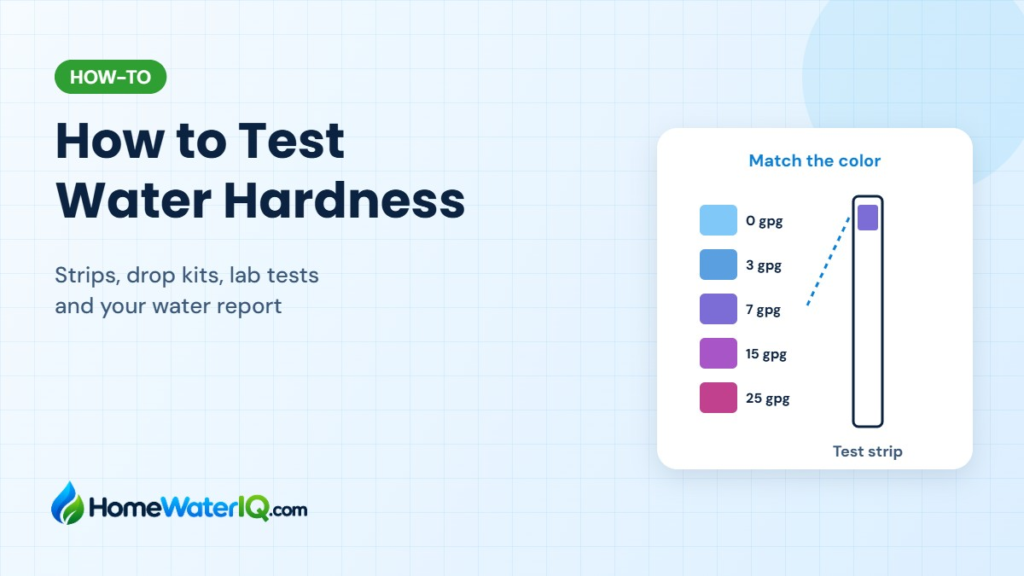
The catch is resolution. Strips read in color blocks, not exact numbers. One maker’s chart, for example, jumps from 3 to 7 gpg with nothing in between, and telling two similar shades apart in kitchen light is a judgment call. Many strips also top out around 25 gpg (425 ppm), so very hard well water can max them out. Use strips to tell soft from hard or to confirm your softener is working, not to dial in a precise setting.
How to use hardness test strips
- Use a cold-water tap that isn’t softened or filtered. If you have a softener, test at an outdoor spigot that bypasses it, or put the softener on bypass.
- Run the water for about 30 seconds, then fill a clean glass. Rinse the glass first so soap residue doesn’t skew the reading.
- Dip the strip for the time on the package (often 1 to 3 seconds) and shake off the excess.
- Wait the stated time, usually 15 to 30 seconds, and compare the color in daylight. Reading too late can shift the color.
- Write down the reading and the units on the chart (gpg or ppm). If you land between two blocks, call it the higher one.
Method 3: titration drop kit (the best DIY accuracy)
A drop kit is what water treatment pros use in the field. You add an indicator that turns the sample pink or red, then add a titrant one drop at a time until it turns blue. With the Hach 5-B, each drop equals 1 gpg, so 14 drops means 14 gpg. Hach rates it for 1 to 30 gpg (17 to 513 mg/L) and about 100 tests.
That 1 gpg resolution is the reason to buy one. If you’re entering hardness into a softener’s control valve or sizing a new unit, the difference between 10 and 17 gpg matters, and a strip may show both as “hard.”
How to use a hardness drop kit (Hach 5-B style)
- Collect untreated cold water the same way as for strips.
- Fill the sample tube exactly to the line. The Hach tube holds 5.83 mL, which is what makes one drop equal 1 gpg.
- Add the indicator (Hach uses one level spoonful of UniVer 3 powder) and swirl. Pink or red means hardness is present; blue means the water is already soft.
- Add titrant one drop at a time, holding the bottle straight up and swirling after each drop.
- Stop when the color turns fully blue with no purple tint. Count the drops: that’s your hardness in gpg.
- Rinse the tube well. Repeat once to confirm; two results within a drop of each other are a good sign.
Other kits work the same way with different scales. LaMotte’s 4482-DR-LI-01 uses a direct-reading titrator that reads 0 to 200 ppm in 4 ppm steps over 50 tests. It’s precise, but 200 ppm is only about 11.7 gpg, so it can run out of range on very hard water.
Method 4: a certified lab test (best for wells)
If you have a private well, nobody else is testing your water. A lab test gives you an exact hardness number plus the things that change your treatment plan, like iron, manganese, pH, nitrate and bacteria. Iron in particular matters for softener sizing and salt choice.
The Minnesota Department of Health suggests using a lab accredited by its Environmental Laboratory Accreditation Program; other states run similar certification programs, and your county health department or extension office can point you to one. Follow the lab’s bottle and shipping instructions exactly. Once you have results, see our guides to the best water filters for well water and the best water softener for well water.
Why a TDS meter is not a hardness test
Pocket TDS meters are cheap and popular, and they often get sold as hardness testers. They aren’t. A TDS meter measures electrical conductivity and converts it to an estimate of total dissolved solids. That includes calcium and magnesium, but also sodium, chloride, sulfate, bicarbonate and anything else dissolved in the water.
Two waters with the same TDS can have very different hardness. And a softener swaps calcium and magnesium for sodium, so the TDS of softened water stays about the same even though the hardness drops to near zero. A TDS meter can’t tell you whether your softener works. It’s useful for checking a reverse osmosis system, which does lower TDS; see our best reverse osmosis systems.
The soap-bottle test (rough only)
Hard water reacts with soap and makes less lather, which is how hardness was first defined. To try it, fill a clear bottle about a third full of tap water, add a few drops of pure liquid soap such as castile (not detergent, which lathers in hard water too), cap it and shake hard for 10 seconds.
Lots of fluffy suds and clear water below suggests soft water. Few suds and cloudy, milky water suggests hard water. That’s all it tells you. There’s no number, and the result depends on how much soap you used. If it hints at hard water, confirm it with strips or a drop kit. For other clues, see our list of signs of hard water.
How to read your results and convert units
Hardness is reported “as calcium carbonate” in one of three units. Milligrams per liter (mg/L) and parts per million (ppm) are effectively the same for drinking water. Softener makers use grains per gallon (gpg). One gpg equals 17.1 mg/L, so divide mg/L by 17.1 to get gpg. A utility report showing 250 mg/L means about 14.6 gpg. Our water hardness converter does the math for you.
The USGS uses these classes:
| USGS class | mg/L (ppm) as CaCO3 | Grains per gallon |
|---|---|---|
| Soft | 0 to 60 | 0 to 3.5 |
| Moderately hard | 61 to 120 | 3.6 to 7.0 |
| Hard | 121 to 180 | 7.1 to 10.5 |
| Very hard | Over 180 | Over 10.5 |
Hardness itself isn’t a health concern. The USGS notes that calcium and magnesium aren’t toxic, and the EPA has no legal limit for hardness. The question is whether the scale and soap scum bother you, and what they cost you in cleaning and appliance wear.
What to do next
- Under about 3.5 gpg (soft): no treatment needed for hardness.
- About 3.5 to 7 gpg (moderately hard): optional. Many people live with it; a salt-free conditioner from our salt-free softener picks can cut scale without salt.
- Over 7 gpg (hard to very hard): a salt-based softener is the proven fix. The Minnesota Department of Health says softening may be needed above 7 gpg (120 mg/L). Enter your number in our water softener size calculator, then compare the best water softeners. Our water softener cost calculator estimates salt and water costs at your hardness.
If you already own a softener, test both the untreated water and a softened tap. Softened water should read near 0 gpg. If it doesn’t, check the salt level, look for a salt bridge, and make sure the hardness setting matches your test. Our guide to how a water softener works explains the regeneration cycle.
Best hardness test kits
| Kit | Type | Range | Resolution | Tests | Price |
|---|---|---|---|---|---|
| Hach 5-B (145300) | Drop titration | 1 to 30 gpg | 1 gpg per drop | About 100 | About $35 to $55 |
| LaMotte 4482-DR-LI-01 | Direct-reading titrator | 0 to 200 ppm | 4 ppm | 50 | Check retailer |
| Varify hardness strips | Test strips | 0 to 425 ppm (0 to 25 gpg) | Color blocks | 150 | About $10 |
| JNW Direct hardness strips | Test strips | Reads in gpg (chart) | Color blocks | 150 | About $9 |
Hach 5-B is the pick if you’re buying or programming a softener. It’s a pro-grade kit with enough reagent for about 100 tests, and the drop count gives you a direct gpg number. Prices we found ranged from about $35 to $56 depending on the seller. LaMotte 4482-DR-LI-01 is a precise alternative for soft to hard water, but its 200 ppm ceiling is low for very hard wells. Varify and JNW Direct strips are fine for quick checks and for spot-checking softened water every month or two.
Check Hach 5-B price on Amazon
Check Varify strips price on Amazon
FAQ
How accurate are water hardness test strips?
Accurate enough to tell soft from hard, not precise enough to set a softener. They read in color blocks that can be several gpg apart, and matching shades is subjective. For a number you’ll program into a softener, use a drop kit like the Hach 5-B or a lab test.
Can I use a TDS meter to test water hardness?
No. A TDS meter estimates all dissolved solids, not just calcium and magnesium. Softened water often reads about the same TDS as hard water because sodium replaces the hardness minerals, so the meter can’t tell you whether your water is hard or your softener is working.
How do I convert ppm to grains per gallon?
Divide ppm (or mg/L) by 17.1. For example, 200 ppm is about 11.7 gpg, and 300 ppm is about 17.5 gpg. To go the other way, multiply gpg by 17.1. Our hardness converter handles it instantly.
Where do I find my city’s water hardness?
Check your utility’s annual Consumer Confidence Report, which the EPA requires utilities to deliver by July 1 each year. Look on the utility’s website or use the EPA’s CCR search. If hardness isn’t in the report, call the utility and ask for the typical range.
How often should I test my water hardness?
Test untreated water once before buying or setting a softener, and again if your utility changes sources or your well water changes. If you own a softener, a quick strip test of softened water every month or two confirms it’s still working.
Sources: EPA, Consumer Confidence Reports; EPA, CCR information for consumers; USGS, water hardness in the United States; Minnesota Department of Health, home water softening; Hach, Model 5-B total hardness test kit; USABlueBook, Hach 5-B specs; Zoro, Hach 5-B; LaMotte, total hardness test kit 4482-DR-LI-01; FaucetFam, hardness test kit prices; Serim, hardness test strip chart example.
Keep reading
 Clearly Filtered Review (2026): Pitcher, Bottle and Under-Sink
Clearly Filtered claims to reduce 386+ contaminants, including fluoride, but only chlorine, taste and odor are certified. Here's what you…
 AquaTru Review (2026): Countertop RO by the Numbers
AquaTru makes some of the best-certified countertop reverse osmosis purifiers you can buy. Here's what each model costs to run,…
 Waterdrop Review 2026: Which Waterdrop Filter Is Worth Buying?
Waterdrop sells some of the most popular tankless RO systems on Amazon, but its certifications vary a lot from model…