

HomeWaterIQ is reader-supported. When you buy through links on this page, we may earn a commission at no extra cost to you. As an Amazon Associate, we earn from qualifying purchases.
Short answer: the Waterdrop to buy is the G3P600 (about $440), a tankless RO certified by IAPMO R&T to NSF/ANSI 58 with a 2:1 pure-to-drain ratio. Big households should step up to the G3P800 (about $790 to $850). If you just want better-tasting tap water, the 15UA under-sink filter (about $54) is cheap to run, but it’s certified for chlorine taste and odor only. For countertop RO, the K19-H (about $259) carries an NSF/ANSI 58 listing, while the popular C1S and K6 are certified only for lead-free materials. Skip Waterdrop’s whole-house cartridges if you need certified contaminant reduction.
We didn’t test Waterdrop products ourselves. We judged them by the numbers: certifier listings versus “tested” claims, output and drain ratio, yearly filter cost, warranty and return terms, price and public customer feedback. Prices are from Waterdrop, Amazon and other retailers as of late October 2026, and Waterdrop changes them often with promo codes.
Waterdrop lineup at a glance
| Model | Type | Certified to (IAPMO R&T unless noted) | Output / capacity | Yearly filters | Warranty | Price |
|---|---|---|---|---|---|---|
| G3P600 | Tankless RO | NSF/ANSI 42, 58, 372 | 600 GPD, 2:1 | About $145 | 1 yr | About $440 |
| G3P800 | Tankless RO + UV | NSF/ANSI 42, 53, 58, 372 (some claims tested only) | 800 GPD, 3:1 | About $160 | 1 yr | About $790 to $850 |
| X12 | Tankless RO, alkaline | NSF/ANSI 42, 58, 372 | 1,200 GPD, 3:1 | About $175 | 1 to 2 yrs (see text) | About $1,099 |
| K19-H | Countertop RO, hot water | NSF/ANSI 58 (TDS), 372 | Batch | Not published | 1 yr | About $259 to $279 |
| K6 | Countertop RO, hot water | NSF/ANSI 372 only | 600 GPD, 2:1 | About $120 | 1 yr | About $799 |
| C1S | Countertop RO | NSF/ANSI 372 only | Batch, 3:1 claimed | About $59 | Not stated | About $209 to $259 |
| 15UA | Under-sink carbon | NSF/ANSI 42 (chlorine taste/odor), 372 | 19,000 gal or 2 yrs | About $18 | Not stated | About $54 |
| 10UA | Under-sink carbon | NSF/ANSI 42 (chlorine taste/odor), 372 | 11,000 gal or 12 months | About $26 to $31 | Not stated | About $40 to $44 |
| WHF21-PG | Whole-house cartridge | NSF/ANSI 372 only | 15 gpm; filters 3 to 6 months | About $72 to $144 | 1 yr | About $120 to $166 |
Who is Waterdrop?
Waterdrop products are made in China by Qingdao Ecopure Filter Co., Ltd., the company named as manufacturer on Waterdrop’s NSF listings, with a factory in Jimo, Qingdao. TapWaterData’s brand profile says the U.S. side is Ecolife Technologies, a California company in Ontario, California, that the Waterdrop brand launched in the U.S. around 2015, and that it’s privately held. Ecopure also makes private-label filters for other brands.
Waterdrop sells tankless RO systems, countertop RO units, under-sink and whole-house filters, pitchers and fridge filters, both on Amazon and on its own site.
Certified vs. tested at Waterdrop
This is the most important thing to understand before you buy. Waterdrop’s pages mix two kinds of claims. Some standards are certified by IAPMO R&T, which keeps a public listing. Many headline claims, such as 99% lead or PFAS reduction, are marked with an asterisk as “tested by a third-party laboratory,” often SGS. Tested is not certified.
Watch for “NSF/ANSI 372 Certified” in particular. That standard only confirms the parts are lead-free. It says nothing about what the filter removes, and it’s the only certification on the C1S, K6 and whole-house models.
Tankless RO: G3P600, G3P800 and X series
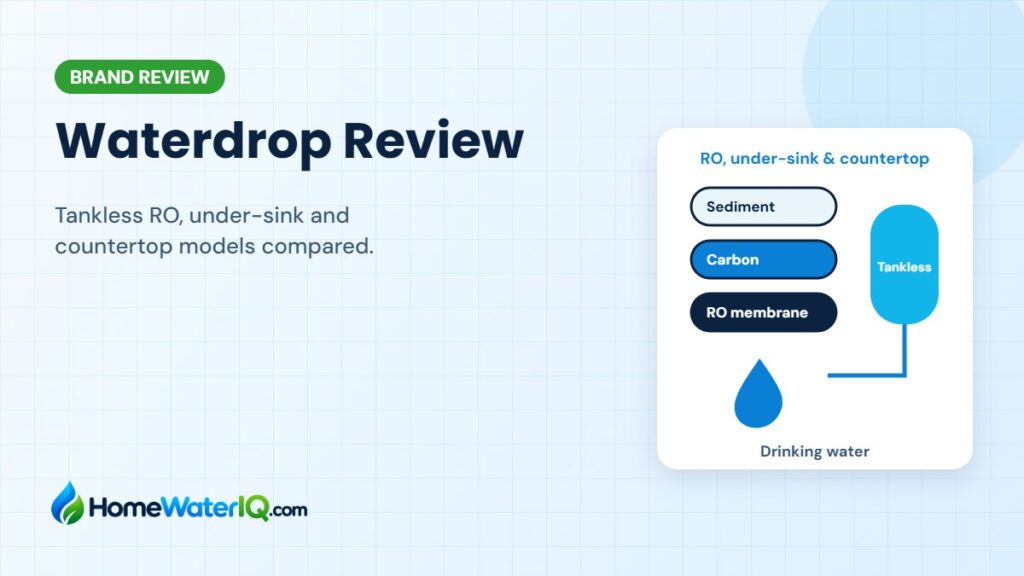
G3P600. Our top reverse osmosis pick. It’s an 8-stage tankless unit rated at 600 GPD with a 2:1 pure-to-drain ratio, far better than the 5:1 or worse EPA says is typical of conventional RO. Waterdrop lists it as certified to NSF/ANSI 58, 42 and 372, and TapWaterData’s directory check also found IAPMO listings covering fluoride and lead under NSF/ANSI 58 and PFOA/PFOS under NSF/ANSI 53. It sat at $439 on both Amazon and Waterdrop’s site in late summer 2026 against a $539 compare-at price, and Amazon deals have dipped to $399.
Filters are $29.99 for the CF prefilter (6 months), $29.99 for the CB carbon block (12 months) and $109.99 for the RO cartridge (24 months), about $145 a year. It needs an outlet under the sink, and the base model doesn’t remineralize; Waterdrop sells bundles with a mineral filter.
G3P800. 800 GPD, a 3:1 ratio, a UV light and a faucet that shows TDS and filter life. Waterdrop says IAPMO R&T certifies it to NSF/ANSI 42, 53, 58 and 372, while lead and some other claims are only lab-tested. Waterdrop’s own price was $849 with a code (regular $999) in October 2026; Home Depot had it for $786.99. Filters run about $160 a year.
X series. Waterdrop’s top line adds alkaline remineralization: the X8-A (800 GPD, $699 sale), X12 (1,200 GPD, $1,099) and X16 (1,600 GPD, $1,599). The X12 is listed by IAPMO R&T under NSF/ANSI 58 (TDS), 42 (chlorine, taste and odor) and 372. Its broader PFAS, fluoride and arsenic claims aren’t on a listing. Filters cost about $175 a year. It wants hardness under 7 grains per gallon (check with our hardness converter), so very hard water needs a softener first. Waterdrop’s service policy says eligible X models get a 2-year warranty, but the X12 Basic page says 1 year, so confirm before buying. Most homes don’t need 1,200 GPD; the G3P600 is better value.
Countertop RO: K19, K6 and C1S
K19-H. IAPMO R&T lists the K19 family under NSF/ANSI 58, with TDS as the only reduction claim, plus NSF/ANSI 372. The base K19-S is discontinued, but the K19-H (with hot water) was $259 on Amazon and $279 direct in September 2026. That makes it the only Waterdrop countertop RO we found with an RO certification.
K6. A 600 GPD countertop unit with instant hot water from 104°F to 203°F and a 2:1 ratio, $799 direct. It’s certified only to NSF/ANSI 372; fluoride, PFOA/PFOS and other reductions are lab-tested. Waterdrop puts filter costs at about $120 a year. You’re paying for the hot water feature, not proven filtration.
C1S. Compact and cheap to run: one C1RF cartridge a year (about $59 at one retailer) and a claimed 3:1 ratio. Waterdrop’s page says IAPMO certifies it only to NSF/ANSI 372; its 99.94% lead and 95% TDS figures come from SGS testing. It was $209 to $259 and sometimes sold out. More options in our best countertop water filters.
Check Waterdrop C1S price on Amazon
Under-sink filters: 10UA and 15UA
Both are single carbon cartridges that connect to your cold line and feed your existing faucet at 0.75 gpm. IAPMO R&T certifies each to NSF/ANSI 42 for one claim, chlorine taste and odor, plus NSF/ANSI 372 for materials. Waterdrop and its Amazon listings also advertise lead and PFAS reduction, but those claims aren’t certified.
The 15UA is rated for 19,000 gallons or 2 years and was $53.99 on Amazon; a $35.99 replacement works out to about $18 a year. The 10UA lasts 11,000 gallons or 12 months, costs $40 to $44, and its cartridge is $30.99 direct or under $26 on Amazon. For lead or PFAS, choose a certified filter from our best under-sink water filters.
Whole-house filters, pitchers and fridge filters
Whole-house (WHF series). These are big-blue cartridge housings. The 2-stage WHF21-PG was $119.99 with a code (regular $165.99), rated for 15 gpm, with $35.99 filters that last 3 to 6 months. The 4-stage WHF2E-PC is $165.99 with filters good for about 50,000 gallons or 6 months. Both are certified only to NSF/ANSI 372. They’re fine for sediment and chlorine taste on a budget, but compare certified options in our best whole-house water filters.
Pitchers. The Chubby 10-cup pitcher’s 200-gallon filter is NSF listed to NSF/ANSI 42 and 372 only, with no certified lead claim. See our best water filter pitchers for certified alternatives.
Refrigerator filters. This is where Waterdrop’s certifications are strongest. NSF lists several Waterdrop fridge filters, such as the WDP-F46 (EFF-6046S), under NSF/ANSI 42, 53 (including lead, cysts and mercury) and 401. Certification varies by model, so look up your exact part number in NSF’s directory.
Smart features
Waterdrop’s “smart” features live on the faucet or unit, not in an app. The G3P800, X series and K6 show real-time TDS and filter-life readings on a display. We didn’t find a smartphone app for Waterdrop’s current U.S. RO systems. The display is handy, but a TDS number only tells you the membrane is working; it doesn’t measure lead or PFAS.
Prices: Amazon vs. Waterdrop direct
Prices are usually close. In late summer 2026 the G3P600 was $439 in both places, and the 15UA was $53.99 on Amazon versus a $57.99 promo price direct. Waterdrop’s site leans on checkout codes and bundles, while Amazon runs periodic deals. Replacement filters are often cheaper on Amazon. Before you choose where to buy, though, read the return policy below.
Warranty and returns
Most Waterdrop RO systems carry a 1-year limited warranty, and Waterdrop says eligible X series models get 2 years. That’s short next to Aquasana’s 10 years on a Rhino or Home Master’s 5 years. The warranty requires feed water within the stated limits for pressure, pH, TDS and hardness.
Direct purchases get a 30-day risk-free return in the continental U.S. After 30 days, returns are still possible with a 10% restocking fee, and items not in like-new condition also take a 10% fee. Waterdrop pays return shipping only on quality problems. The fine print matters for Amazon buyers: Waterdrop’s service policy says orders from third-party sellers, including Amazon, aren’t eligible for its return policy, and that warranty service applies to products bought from its U.S. website. In practice, Amazon purchases fall under Amazon’s return window, so confirm warranty coverage with Waterdrop before you buy there.
Customer service and complaint themes
Waterdrop’s Trustpilot profile showed 4.7 out of 5 from about 11,100 reviews in October 2026, with 85% five-star and 5% one-star. Praise centers on responsive support staff, easy installation, taste and help with replacements. Negative themes include slow or missing replies, delivery delays, and units that leaked on arrival or failed soon after. Waterdrop replies to nearly all negative reviews. Trustpilot notes the company invites customers to leave reviews, which tends to lift scores, so weigh the complaint themes as much as the average.
Waterdrop pros and cons
- Pro: G3P600 and G3P800 combine NSF/ANSI 58 certification with efficient 2:1 and 3:1 ratios
- Pro: Compact tankless designs and fast flow
- Pro: Low yearly filter costs on the 15UA, 10UA and C1S
- Pro: Strong Trustpilot rating; widely sold on Amazon and at home centers
- Con: Many headline claims (lead, PFAS) are lab-tested, not certified
- Con: Several models certified only to NSF/ANSI 372, a materials standard
- Con: Mostly 1-year warranties
- Con: Return and warranty terms exclude Amazon purchases, per Waterdrop’s policy
Who should buy Waterdrop, and who shouldn’t
Buy it if you want a certified tankless RO for under $500, you’re short on cabinet space, or you only want better-tasting water from a cheap, long-life under-sink cartridge.
Skip it if you need certified lead or PFAS reduction from an under-sink carbon filter (look at Aquasana’s Claryum, covered in our Aquasana review), you want a long warranty, you have no outlet under the sink, or you need whole-house treatment for a well; see our best water filter for well water.
Verdict: which Waterdrop to buy
- Best overall: G3P600, certified, efficient and about $145 a year in filters.
- Big households: G3P800 for 800 GPD, a 3:1 ratio and UV.
- Taste only, cheapest: 15UA.
- Countertop RO: K19-H if you want an NSF/ANSI 58 listing; the C1S only if low running cost matters more than certification.
- Skip: the K6 unless you want hot water, X12/X16 unless you need very high output, and WHF whole-house filters for anything beyond sediment and taste.
FAQ
Is Waterdrop NSF certified?
Some models are. The G3P600, G3P800, X12 and K19 are certified by IAPMO R&T to NSF/ANSI 58, several fridge filters are NSF listed, and the 10UA and 15UA are certified to NSF/ANSI 42 for chlorine taste and odor only. The C1S, K6 and whole-house filters are certified only to NSF/ANSI 372 for lead-free materials.
Is Waterdrop a Chinese company?
The products are made by Qingdao Ecopure Filter Co. in China, the manufacturer named on Waterdrop’s NSF listings. The brand is sold in the U.S. through a California-based company, according to TapWaterData’s brand profile.
Does Waterdrop reverse osmosis remove fluoride and PFAS?
RO generally reduces both, and the G3P600 has IAPMO listings that include fluoride and PFOA/PFOS, per TapWaterData. On other models, those claims are lab-tested rather than certified, so check the listing for your exact model.
Should I buy Waterdrop on Amazon or direct?
Prices are usually similar. Waterdrop’s policy says its returns and warranty service cover purchases from its own U.S. site, so buying direct gives you the clearest coverage, while Amazon gives you Amazon’s return window.
How long do Waterdrop RO filters last?
On the G3 series, the prefilter lasts 6 months, the carbon block 12 months and the RO membrane 24 months. Budget about $145 to $175 a year for Waterdrop’s tankless systems.
Sources: TapWaterData, Waterdrop brand profile; NSF, Waterdrop WDP-F46 listing; TapWaterData, G3P600; Waterdrop, G3P600 RO filter; Slickdeals, G3P600 Amazon deal; Waterdrop, G3P800; Home Depot, G3P800; Waterdrop, X series; TapWaterData, X12; TapWaterData, K19; Waterdrop, K6; Waterdrop, C1S; Home Outlet Direct, C1RF filter; TapWaterData, 15UA; TapWaterData, 10UA; Waterdrop, WHF21-PG; Waterdrop, WHF2E-PC; Waterdrop, Chubby pitcher; Waterdrop, service policy; Trustpilot, Waterdrop; EPA WaterSense, point-of-use RO.
Keep reading
 Clearly Filtered Review (2026): Pitcher, Bottle and Under-Sink
Clearly Filtered claims to reduce 386+ contaminants, including fluoride, but only chlorine, taste and odor are certified. Here's what you…
 AquaTru Review (2026): Countertop RO by the Numbers
AquaTru makes some of the best-certified countertop reverse osmosis purifiers you can buy. Here's what each model costs to run,…
 Aquasana Review 2026: What to Buy and What to Skip
Aquasana sells everything from shower filters to whole-house systems, and its certifications range from strong to marketing-only. We sorted the…