

HomeWaterIQ is reader-supported. When you buy through links on this page, we may earn a commission at no extra cost to you. As an Amazon Associate, we earn from qualifying purchases.
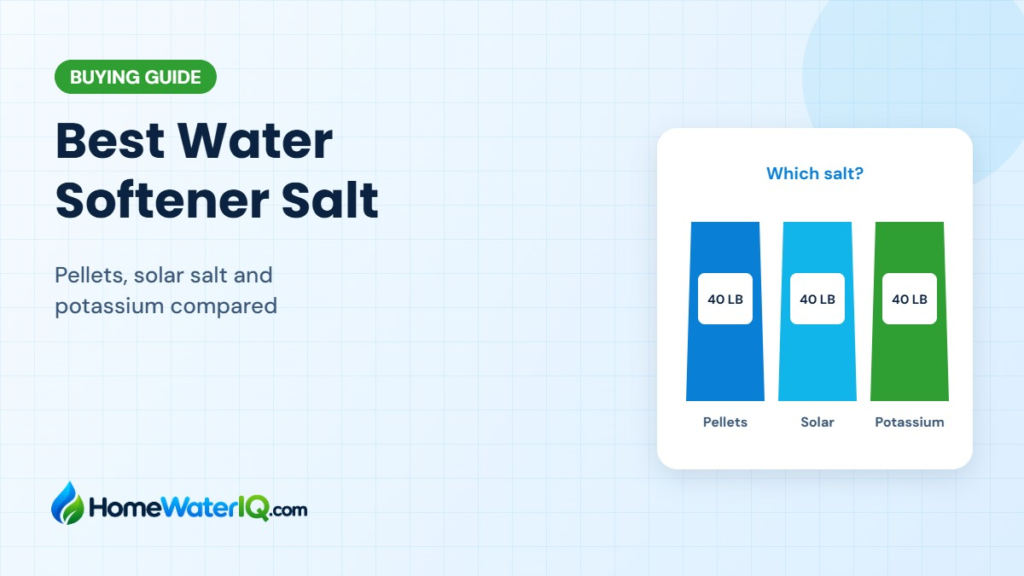
Short answer: the best water softener salt for most homes is Morton Clean and Protect pellets (about $8 to $9 per 40-lb bag) or Diamond Crystal Bright & Soft pellets (about $9, listed at 99.8% pure). If your water has some iron, step up to Morton Clean and Protect Plus Rust Defense (about $10). For a cheaper option that still works in most softeners, solar crystals like Diamond Crystal Solar Naturals (about $8.60) or Morton Pure and Natural (about $9) are fine. To avoid adding sodium, Diamond Crystal Potassium Chloride (about $29 to $35 a bag) costs three to four times more and you’ll need roughly 10% more of it.
We didn’t run these salts through our own softener. We compared them by the numbers: purity, insoluble content, NSF certification, additives, price per bag and yearly cost for a typical family. Prices come from Walmart, Ace Hardware, Costco and farm-store listings in 2026. Salt prices vary a lot by store and region, and big-box chains like Home Depot and Lowe’s often show prices only for your local store, so check before you buy.
Best water softener salt at a glance
| Best for | Salt | Type | Purity (maker) | Price, 40 lb |
|---|---|---|---|---|
| Best overall | Morton Clean and Protect | Pellets | Not published | About $8 to $9 |
| Highest listed purity | Diamond Crystal Bright & Soft | Pellets | 99.8% | About $9 |
| Iron in water | Morton Clean and Protect Plus Rust Defense | Pellets with iron additive | Not published | About $10 |
| Best value crystals | Diamond Crystal Solar Naturals | Solar crystals | 99.6% | About $8.60 |
| Solar crystals, wide availability | Morton Pure and Natural | Solar crystals | Not published | About $9 |
| Sodium-free | Diamond Crystal Potassium Chloride | Potassium chloride | 99.2% KCl (typical) | About $29 to $35 |
| Sodium-free pellets | Morton Potassium Chloride | Potassium chloride pellets | “99% sodium free” | Often $50+ |
Morton Clean and Protect: best overall
Clean and Protect is the default pellet at most home centers and grocery stores, which is half its appeal: you can find it almost anywhere. Morton says it’s formulated to reduce bridging and mushing, the two most common brine tank problems, and it’s NSF listed according to retailer pages. Walmart.com listed the 40-lb bag at $8.34 in mid-2026; third-party sellers online often charge two to three times that, so buy it in a store.
Morton suggests keeping the tank at least half full and adding about two bags every two months, depending on household size. A 25-lb bag is also sold, which helps if lifting 40 pounds is hard. The one gap: Morton’s page doesn’t publish a purity figure for this product, unlike Diamond Crystal.
Check Clean and Protect on Amazon
Diamond Crystal Bright & Soft: highest listed purity
Diamond Crystal (made by Cargill) lists Bright & Soft at about 99.8% pure, with more than 99.7% of it water-soluble. That means very little sludge left behind in the brine tank. It’s certified to NSF/ANSI/CAN 60, the standard for drinking water treatment chemicals, and Diamond Crystal says the pellets are made to resist mushing and bridging.
Ace Hardware listed the 40-lb bag at $8.99, and it’s also sold in 50-lb bags. If you can buy either this or Morton Clean and Protect for the same price, choose this one for the published purity. In practice, both work well in any standard softener.
Morton Clean and Protect Plus Rust Defense: best for iron
If you see orange stains in sinks or toilets, some iron is getting into your softener. Iron fouls the resin over time. Rust Defense pellets include an additive that helps clean iron out of the resin during each regeneration; Morton says it removes 10 times more iron than plain salt, based on its own lab testing. Walmart.com listed it around $9.50 to $9.90 in 2026.
Know the limits. Iron-fighting salt helps a softener handle small amounts of iron. It is not an iron filter, and Morton doesn’t publish a maximum iron level. If your well has a lot of iron or manganese, add a dedicated iron filter; see our best water filters for well water and best water softener for well water. Diamond Crystal sells a similar iron-reducing pellet if that’s what your store stocks.
Diamond Crystal Solar Naturals: best value crystals
Solar salt is made by evaporating seawater or brine in open ponds with sun and wind. Diamond Crystal lists Solar Naturals at a typical 99.6% purity with low insolubles, certified to NSF/ANSI/CAN 60, and recommends it for all water softeners. Ace listed the 40-lb bag at $8.59.
Crystals are slightly less pure than the best pellets, so expect a bit more residue and an occasional tank clean-out. Some softener makers prefer crystals for certain brine tank designs, so check your manual. We list it in plain text because large salt bags are mainly a store purchase.
Morton Pure and Natural: solar crystals you can find anywhere
Pure and Natural is Morton’s solar crystal salt, sold at hardware stores, grocery chains and warehouse clubs. Ace listed it at $8.99 for 40 lb. Morton describes it as all-natural and high purity but doesn’t publish a percentage on the page we checked. Choose it or Solar Naturals based on what’s cheaper near you.
Diamond Crystal Potassium Chloride: best sodium-free salt
Potassium chloride (KCl) softens water the same way, but it trades hardness for potassium instead of sodium. Cargill’s spec sheet lists Diamond Crystal’s KCl at a typical 99.2% purity with about 160 ppm insolubles, certified to NSF/ANSI/CAN 60, with no additives. Costco members have seen Cargill potassium chloride for about $29 a bag, and Farm & Home Supply listed it at $34.99.
Cargill notes that people being treated for kidney or heart disease, high blood pressure or diabetes should talk to their doctor before drinking water softened with potassium chloride. It’s the right pick if you want to cut sodium; otherwise, the cost is hard to justify.
Check potassium chloride on Amazon
Morton Potassium Chloride: sodium-free pellets
Morton’s version comes as pellets and is labeled “99% sodium free.” Morton recommends keeping the tank at least half full and adding about a bag a month. Prices swing widely: online marketplace sellers listed it near $60, and Angi puts potassium chloride at $50 to $70 per 40-lb bag. Check warehouse clubs and local hardware stores, which are often cheaper.
Check Morton potassium chloride on Amazon
Types of water softener salt explained
| Type | Typical purity | Residue | Cost per 40 lb | Notes |
|---|---|---|---|---|
| Evaporated salt pellets | About 99.9% | Very low | About $8 to $10 | Purest; best for most softeners |
| Solar salt crystals | About 99.6% | Low | About $8 to $9 | Good value; occasional clean-out |
| Rock salt | About 95% to 99% | Higher | Cheapest | Insoluble minerals build up as sludge |
| Iron-fighting pellets | Varies | Low | About $10 | Additive helps clean iron from resin |
| Potassium chloride | About 99% | Low | About $29 to $70 | No sodium added; use about 10% more |
Evaporated salt is made by dissolving underground salt deposits, then evaporating the brine with heat. Angi puts its purity around 99.9%. It’s pressed into pellets, which dissolve evenly. Solar salt is cheaper and over 99% pure. Rock salt is mined and has the most impurities, mainly calcium sulfate according to Angi, which settle as sludge and mean more frequent tank cleaning. Saving a dollar or two a bag rarely pays off with rock salt.
Don’t use ice-melt salt, which can contain additives, or fine table salt, which packs into a mushy layer. Salt blocks exist, but Angi notes you should use them only if your softener’s manual calls for them.
How much salt will you use?
It depends on your hardness, water use and softener efficiency. Here’s the example from our water softener cost guide: a family of four using 300 gallons a day with 15 grains per gallon of hardness needs about 1.64 million grains removed a year. A softener that just meets the NSF/ANSI 44 efficiency minimum (3,350 grains per pound of salt) uses about 490 pounds a year. That’s roughly 12 bags, or about $100 a year at $8 a bag.
Potassium chloride changes the math. North Dakota State University Extension says it binds less efficiently, so about 10% more is used. That’s about 540 pounds, or 13 to 14 bags, which at $29 to $60 a bag works out to roughly $400 to $800 a year. Plug your own hardness and water use into our water softener cost calculator, and check your hardness in gpg with our hardness converter if your test is in ppm.
An older timer-based softener, a hardness setting higher than your real water, or an oversized unit can push salt use well above these numbers. If you haven’t tested lately, see how to test water hardness.
Potassium vs. sodium: how much sodium does softened water add?
A sodium softener adds about 8 mg of sodium per liter for every grain per gallon of hardness it removes, according to NDSU Extension. At 15 gpg, that’s about 120 mg per liter, or roughly 28 mg in an 8-ounce glass. The Dietary Guidelines for Americans recommend under 2,300 mg a day, so a glass of softened water adds around 1% of that. At very high hardness or for people on a strict low-sodium diet, it adds up.
You have three ways to cut it. Switch to potassium chloride (expensive). Leave one kitchen cold tap unsoftened, which NDSU suggests. Or add a reverse osmosis system for drinking water, which removes most of the sodium. Note that potassium chloride still discharges chloride, so it doesn’t solve salt-discharge concerns; the Minnesota Department of Health lists environmental impacts from salt use as a drawback of softening. If that matters where you live, look at salt-free water softeners.
Salt bridges and salt mushing: how to fix them
If your water turns hard again but the salt tank looks full, you probably have a salt bridge: a hard crust that forms across the tank with an empty gap below it. Water can’t reach the salt, so no brine is made. A salt mush is the opposite: dissolved salt recrystallizes into a thick sludge at the bottom that blocks the brine intake.
- Check for a bridge. Push a broom handle gently down into the salt. If it hits a hard layer and then drops through, you’ve found one.
- Break it up gently. Tap the crust with the broom handle until it collapses. Don’t hammer at the tank walls; plastic brine tanks crack.
- Loosen stubborn crust with warm water. Pour a little warm water over it, wait, then break it up.
- Clear mush. Scoop out the sludge and old salt, drain any standing brine, rinse the tank, then refill with fresh pellets.
- Regenerate manually. Start a regeneration from the control valve so the resin recharges right away.
To prevent it, don’t overfill: keep the salt about half to two-thirds up the tank, as Morton’s half-full guidance suggests. Use high-purity pellets, avoid fine or cheap salt, and keep the softener out of humid spots. Check the tank once a month.
How to choose water softener salt
Start with your softener’s manual
Most softeners take pellets or crystals, but some specify one form, and a few require blocks. Following the manual also protects your warranty. If you’re shopping for a new unit, our best water softeners guide and how a water softener works explainer cover the basics.
Pick the purest salt your budget allows
Pellets and solar crystals cost nearly the same per bag, so the purer option is usually worth it. Look for NSF/ANSI/CAN 60 certification, which covers chemicals used to treat drinking water, including softener regenerant salt.
Match the salt to your water
Rust stains or a well with some iron: use iron-fighting pellets. City water with no iron: plain pellets or crystals. A household member limiting sodium: potassium chloride or an RO system at the kitchen sink.
Think about weight and delivery
You’ll haul about 12 bags a year in our example. Morton sells 25-lb bags, and many home centers and grocery chains offer delivery. Online marketplace prices for 40-lb bags are often several times store prices.
FAQ
Are pellets or crystals better for a water softener?
Pellets are usually better. Evaporated salt pellets are the purest and leave the least residue, which means fewer tank cleanings and less bridging. Solar crystals are a fine, slightly cheaper choice for most softeners, and a few brine tank designs prefer them, so check your manual.
How often should I add salt to my water softener?
Check monthly and keep the tank at least half full, as Morton recommends. A family of four with 15 gpg water uses about a bag a month, or roughly 12 bags a year. Harder water, more people or an older timer-based softener means more frequent refills.
Is potassium chloride worth the extra cost?
Only if you need to limit sodium. It costs roughly three to eight times more per bag and you need about 10% more of it, so yearly costs run roughly $400 to $800 instead of about $100. Leaving one kitchen tap unsoftened or adding an RO filter is often a cheaper way to avoid the sodium.
Can I use rock salt or ice-melt salt in a water softener?
Rock salt works, but its insoluble minerals build up as sludge, so you’ll clean the tank more often. Never use ice-melt products, which can contain additives that aren’t meant for drinking water or your softener’s resin.
How much sodium does a water softener add to drinking water?
About 8 mg per liter for each grain per gallon of hardness removed, according to NDSU Extension. At 15 gpg, that’s about 28 mg in an 8-ounce glass, around 1% of the 2,300 mg daily limit in the Dietary Guidelines.
Sources: Diamond Crystal, Bright & Soft pellets; Diamond Crystal, Solar Naturals crystals; Cargill, Diamond Crystal potassium chloride spec sheet; Morton, Clean and Protect; Morton, Clean and Protect Plus Rust Defense; Morton, Potassium Chloride pellets; AisleGopher, Morton Clean and Protect Walmart price; AisleGopher, Rust Defense Walmart price; Ace Hardware, Bright & Soft; Ace Hardware, Solar Naturals; Ace Hardware, Morton Pure and Natural; Farm & Home Supply, Diamond Crystal potassium chloride; Warehouse Runner, Costco potassium chloride price; Walmart, Morton Potassium Chloride; Angi, types of water softener salt; NDSU Extension, water softening; Minnesota Department of Health, home water softening.
Keep reading
 How Does a Water Softener Work? Ion Exchange and Regeneration Explained
A water softener swaps the calcium and magnesium in your water for sodium or potassium, then cleans itself with salt…
 SpringWell Water Softener Review (2026): Specs, Real Price and Fine Print
SpringWell sells strong-flowing softeners with a lifetime warranty, but no system-level certification. We break down the SS, FutureSoft and combo…
 SpringWell vs. Aquasana: Which Brand Should You Buy?
SpringWell and Aquasana both sell whole-house filters, well systems, softeners and drinking water filters online. We compared them by certifications,…