

HomeWaterIQ is reader-supported. When you buy through links on this page, we may earn a commission at no extra cost to you. As an Amazon Associate, we earn from qualifying purchases.
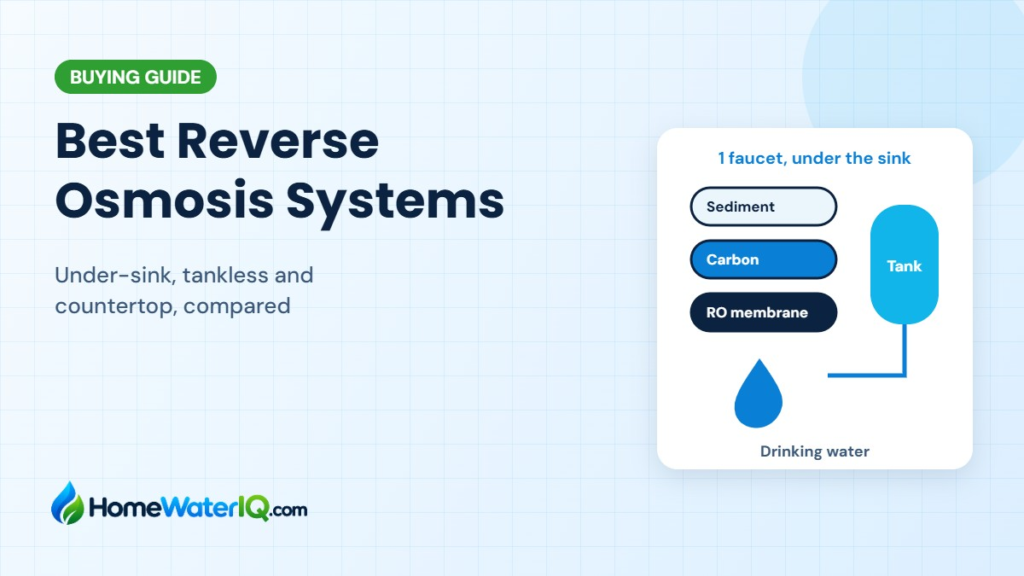
Short answer: the best reverse osmosis system for most homes is the Waterdrop G3P600 (about $440). It’s a tankless under-sink unit certified to NSF/ANSI 58, it makes 600 gallons per day, and it sends only one gallon down the drain for every two it filters. On a tight budget, the iSpring RCC7AK (about $240) and APEC ROES-50 (about $200) are classic tank systems with NSF/ANSI 58 certification. For better-tasting, mineralized water, look at the Home Master TMAFC. Renters who can’t drill a sink should get the countertop AquaTru Classic.
We didn’t install these systems ourselves. We picked them by the numbers: third-party certifications, gallons per day (GPD), drain ratio, yearly filter cost, warranty and price. Prices are U.S. prices from manufacturer sites and major retailers as of late October 2026, and they change often, so check before you buy.
Best reverse osmosis systems at a glance
| Best for | System | Type | GPD | Pure:drain | Remineralization | Price |
|---|---|---|---|---|---|---|
| Best overall | Waterdrop G3P600 | Tankless under-sink | 600 | 2:1 | No (add-on available) | About $440 |
| Best budget | iSpring RCC7AK | Tank under-sink | 75 | Not published | Yes | About $240 |
| Lowest price | APEC ROES-50 | Tank under-sink | 50 | Not published | No | About $200 |
| Best-tasting water | Home Master TMAFC | Tank under-sink | 50 (75 optional) | Not published | Yes (calcium, magnesium) | About $330 |
| Highest output | Waterdrop G3P800 | Tankless under-sink | 800 | 3:1 | No (separate model) | About $790+ |
| Budget tankless | Frizzlife PD600-TAM3 | Tankless under-sink | 600 | 2:1 | Yes | About $400 |
| Renters (countertop) | AquaTru Classic | Countertop | n/a (batch) | About 3:1 (75% efficiency) | Optional filter | About $450 list |
Waterdrop G3P600: best overall
The G3P600 hits the best balance of certification, efficiency and cost. Waterdrop lists it as certified to NSF/ANSI 58 (the reverse osmosis standard), NSF/ANSI 42 (chlorine, taste and odor) and NSF/ANSI 372 (lead-free materials). It’s an 8-stage tankless unit rated at 600 GPD with a 2:1 pure-to-drain ratio, which is far better than the 5:1 or worse that EPA says is typical of conventional RO.
Because there’s no storage tank, it fits in a crowded sink cabinet and fills a glass fast. The trade-off is that it uses a built-in pump, so you need an electrical outlet under the sink.
Filter costs are easy to plan. The CF prefilter lasts up to 6 months ($29.99), the CB carbon block up to 12 months ($29.99) and the RO cartridge up to 24 months ($109.99) on Waterdrop’s site. That works out to roughly $145 a year. Waterdrop’s warranty is 1 year. The base model doesn’t add minerals back; Waterdrop sells a version bundled with a mineral filter.
iSpring RCC7AK: best budget
The RCC7AK is a traditional 6-stage system with a pressurized storage tank, a 75 GPD membrane and an alkaline remineralization stage that adds minerals back after the membrane. It lists at $239.99 on iSpring’s site.
Be precise about what’s certified. NSF’s directory lists the base RCC7AK under NSF/ANSI 58 for TDS (total dissolved solids) reduction. Other contaminant claims on retail listings aren’t covered by that listing, so treat them as manufacturer claims.
iSpring says its prefilters last up to a year and the membrane up to three years, depending on your water. It sells a one-year replacement set (F9K). The tank takes up a good chunk of cabinet space, and iSpring doesn’t publish a drain ratio, so expect more wastewater than a tankless unit. Warranty is 1 year. iSpring also sells an RCC7AK-UV version (about $350) that adds a UV stage.
APEC ROES-50: lowest price with NSF/ANSI 58
The ROES-50 is a plain, proven 5-stage tank system for about $200. It’s certified to NSF/ANSI 58 through the Water Quality Association (WQA Gold Seal), with the certification covering TDS reduction. It comes with a 4-gallon tank and a designer faucet.
Upkeep is cheap. APEC’s three-piece prefilter set costs about $24 and lasts 6 to 12 months; the membrane lasts longer and is sold separately. One reviewer estimates about $75 a year in filters. There’s no remineralization stage, so the water tastes very “flat” to some people.
Home Master TMAFC: best-tasting water
The Home Master Artesian Full Contact (TMAFC) is built around taste. Its remineralization stage adds 30 to 60 mg/L of calcium and magnesium from crushed marble, and the modular filters change once a year or every 2,000 gallons. The filter change set is about $80 at TheperfectWater.com.
It has the longest warranty here: 5 years. It needs 40 to 95 psi of feed pressure, or as little as 35 psi with the optional permeate pump, which Home Master says cuts waste by up to 80%. The base system uses a 50 GPD membrane with a 3.2-gallon tank, and a 75 GPD membrane is an option for hard water.
The catch: the retailer listing we checked says the system uses “NSF-certified materials” but doesn’t name a system-level NSF/ANSI 58 certification. If certification matters most to you, choose one of the certified picks above.
Waterdrop G3P800: highest output and efficiency
For big families or a fridge line plus a kitchen faucet, the G3P800 produces 800 GPD with a 3:1 pure-to-drain ratio, the most efficient of our picks. It’s certified by IAPMO R&T to NSF/ANSI 58 for TDS, NSF/ANSI 42 and NSF/ANSI 372; Waterdrop also lists NSF/ANSI 53. Waterdrop notes that some claims, such as certain heavy metals and VOCs, are tested by a third-party lab rather than certified.
It adds a UV light and a smart faucet that shows TDS readings. Filters run $29.99 (CF, 6 months), $29.99 (CB, 12 months) and $139.99 (RO, 24 months), or roughly $160 a year. Home Depot had it for $786.99 in late October 2026; Waterdrop’s own price varies with promo codes. A remineralizing version is sold separately.
Frizzlife PD600-TAM3: budget tankless with minerals
The PD600-TAM3 gives you tankless speed (600 GPD, 2:1 ratio) plus a remineralization stage for about $400. Frizzlife says the mineral stage raises pH above 7.5 and adds 10 to 30 ppm of TDS back.
Filter costs are the lowest of the tankless picks: $33.99 for the carbon prefilter (12 months), $85.99 for the RO cartridge (24 months) and $29.99 for the mineral cartridge (12 months), or about $107 a year. Warranty is 1 year.
Read the fine print on certification. Frizzlife’s page says the system was “tested” by SGS to NSF/ANSI 42, 53 and 58 and is certified to NSF/ANSI 372 for lead-free materials. Tested-to is not the same as certified. Check the IAPMO or NSF listing before you rely on specific contaminant claims.
Check PD600-TAM3 price on Amazon
AquaTru Classic: best countertop RO for renters
The AquaTru Classic sits on the counter and plugs into the wall. You fill a tank, it filters into a clean-water reservoir of 0.75 gallon, and you pour out the wastewater. No drilling, no plumbing, and it moves with you.
Its certification list is the broadest here. IAPMO R&T lists AquaTru under NSF/ANSI 42, 53, 58 and 401, and reviewers cite reduction claims for about 84 contaminants. AquaTru’s data sheet gives a 75% efficiency rating, or about 3 gallons purified per gallon sent to drain (its 80% recovery rating, about 4:1, is the figure some reviewers quote). Filters cost about $130 a year at list prices, less with combo packs. See our full AquaTru review.
List price is about $450 to $475, and it’s often discounted. It’s a batch system, so it’s slower than under-sink RO and you’ll refill it a few times a day for a family. A smaller AquaTru Carafe model and an alkaline version are also sold.
Check AquaTru Classic price on Amazon
What reverse osmosis removes (and what it doesn’t)
RO pushes water through a very fine membrane. The Connecticut Department of Public Health says it’s effective against many inorganic contaminants, including nitrate, lead and fluoride, and it reduces TDS, sulfate and chloride. EPA and the Minnesota Department of Health both list RO as effective for PFAS (“forever chemicals”). NSF/ANSI 58 also allows optional claims for arsenic, nitrate/nitrite, chromium, radium and more.
RO alone isn’t the answer for everything. It doesn’t reliably remove dissolved gases or most volatile organic compounds, which is why good systems pair the membrane with carbon filters. Connecticut’s health department also says RO alone isn’t recommended for bacteria. If you’re on a private well, test the water first.
RO also treats only the water at one tap. For chlorine, sediment or iron throughout the house, see our guide to the best whole-house water filters.
How to choose a reverse osmosis system
Look for NSF/ANSI 58 certification
NSF/ANSI 58 is the standard for point-of-use RO systems. It covers material safety, structural integrity and TDS reduction, which is its only required performance claim. Any other contaminant claim, like arsenic or PFAS, has to be listed separately. Certifiers include NSF, WQA and IAPMO R&T. “Tested to NSF/ANSI 58” means a lab ran the test; it doesn’t mean the product is certified and audited.
Tank vs. tankless
Tank systems (iSpring, APEC, Home Master) are cheaper, don’t need electricity and store 3 to 4 gallons for fast pours. They also take up more space, and flow slows as the tank empties. Tankless systems (Waterdrop, Frizzlife) use a pump to filter on demand, waste less water and fit small cabinets, but they cost more and need an outlet under the sink.
Countertop for renters
If you can’t drill a hole for a faucet or tap a drain line, a countertop unit like the AquaTru is the only real RO option. Expect slower output and some counter space lost.
Drain ratio
EPA says a typical RO system sends five gallons or more down the drain for every gallon of treated water. EPA’s WaterSense label requires 2.3 gallons or less. Our tankless picks claim 2:1 to 3:1 pure-to-drain, meaning far less than one gallon wasted per gallon filtered. If you’re on a septic system, wastewater matters even more.
Remineralization
RO strips out calcium and magnesium along with contaminants. A remineralization stage adds a small amount back and raises pH, which many people prefer for taste. It’s optional; food is the main source of these minerals for most people.
Faucet, space and water pressure
Most under-sink systems need a dedicated faucet, so you’ll use an existing sprayer hole or drill one in the counter. Measure your cabinet, especially for tank systems. Tank systems also depend on house pressure: most want roughly 40 to 80 psi, and Connecticut’s health department notes that normal household pressure is about 40 psi. Below that, choose a tankless unit with a built-in pump or add a permeate or booster pump.
Hard water
Hardness minerals can scale an RO membrane and shorten its life. If your water is very hard, a softener upstream helps the membrane last longer. See our picks for the best water softeners and our explainer on water softener vs. water filter.
Also considered
The Express Water ROALK 10-stage alkaline system costs about $256 at Home Depot, but the listing we checked didn’t name a certification. The Aquasana OptimH2O was listed as no longer available new at Best Buy, so we left it out.
FAQ
Is reverse osmosis water safe to drink every day?
Yes. RO water is low in minerals, but most people get calcium and magnesium mainly from food. If you don’t like the flat taste, pick a system with a remineralization stage.
Does reverse osmosis remove PFAS?
RO is one of the treatments EPA and the Minnesota Department of Health list as effective for PFAS. EPA suggests looking for certification to NSF/ANSI 53 or 58 for PFAS reduction. It also notes that, as of April 2024, those certifications didn’t yet confirm removal down to EPA’s new drinking water levels.
How much water does a reverse osmosis system waste?
It depends on the system. EPA says typical units waste five gallons or more per gallon of filtered water. Newer tankless models claim 2:1 or 3:1 pure-to-drain, and WaterSense-labeled systems must send 2.3 gallons or less down the drain per gallon.
How often do you change RO filters?
Prefilters usually last 6 to 12 months and membranes 2 to 3 years, depending on your water and use. Budget about $75 to $160 a year for the systems on this list.
Can I install a reverse osmosis system myself?
Most homeowners can install an under-sink system in an afternoon with basic tools. The hardest parts are drilling a faucet hole and connecting the drain saddle. A countertop unit needs no installation at all.
Related guides
- Best under-sink water filters
- Best countertop water filters
- Best water filter pitchers
- SpringWell vs. Aquasana
Sources: NSF, NSF/ANSI 58 overview; EPA WaterSense, point-of-use RO systems; EPA, PFAS water filter fact sheet; Connecticut DPH, RO treatment of drinking water; Minnesota Department of Health, PFAS home treatment; Waterdrop, G3P600 filters; Waterdrop, G3P600 RO filter; Waterdrop, G3P800; Home Depot, G3P800; iSpring, RCC7AK; TapWaterData, RCC7AK certification check; TapWaterData, APEC certification check; Abt, APEC ROES-50; TheperfectWater, Home Master TMAFC; Frizzlife, PD600-TAM3; TapWaterData, AquaTru certifications; Water Filter Guru, AquaTru review; Home Depot, Express Water ROALK.
Keep reading
 AquaTru Review (2026): Countertop RO by the Numbers
AquaTru makes some of the best-certified countertop reverse osmosis purifiers you can buy. Here's what each model costs to run,…
 Waterdrop Review 2026: Which Waterdrop Filter Is Worth Buying?
Waterdrop sells some of the most popular tankless RO systems on Amazon, but its certifications vary a lot from model…
 Clearly Filtered Review (2026): Pitcher, Bottle and Under-Sink
Clearly Filtered claims to reduce 386+ contaminants, including fluoride, but only chlorine, taste and odor are certified. Here's what you…