

HomeWaterIQ is reader-supported. When you buy through links on this page, we may earn a commission at no extra cost to you. As an Amazon Associate, we earn from qualifying purchases.
Short answer: for a well with hard water and some clear-water iron, the Whirlpool WHES48 (about $680 to $930) is our top pick: it’s NSF certified and rated for up to 12 ppm of clear-water iron. If you want to buy online, the AFWFilters Iron Pro 2 (about $800 for 48,000 grains) uses fine-mesh resin made for iron. The Morton M45C (about $620) matches the Whirlpool’s 12 ppm iron rating, and a Fleck 5600SXT 48,000-grain kit with 10% crosslink resin (about $800 to $1,200) is the most serviceable choice. For iron, sulfur and hardness in one package, look at the SpringWell well water filter and softener combo (from about $2,940) or the US Water Systems Flexx combo (from about $3,130).
We didn’t install these softeners on our own wells. We picked them by the numbers: published iron and hardness limits, grain capacity, third-party certification, warranty and price. Prices are U.S. prices from manufacturers and retailers as of late October 2026, so check before you buy.
What makes well water different for a softener
A softener is built to remove calcium and magnesium. Well water often brings other problems too, and some of them damage softener resin. Test your well at a state-certified lab before you buy (see how to test water hardness).
Iron: ferrous vs. ferric
Ferrous iron is dissolved: the water comes out clear and turns orange after it sits. A softener can exchange this “clear-water” iron like hardness. Ferric iron is already rust, so the water is cloudy or orange from the tap. Softeners can’t remove it, and the particles coat the resin. Whirlpool’s manual says its softeners don’t remove ferric, bacterial, organically bound or colloidal iron.
Home-center models such as the Whirlpool WHES48 and Morton M45C are rated for up to 12 ppm of clear-water iron. Extension services are more cautious: Penn State says softeners work for iron under 5 mg/L with pH above 6.7, and the University of Nebraska says 5 to 10 ppm depending on the model. Wisconsin requires extra treatment above 5 ppm. We’d add an iron filter above about 3 to 5 ppm. (ppm equals mg/L; our water hardness converter handles the units.)
Iron fouls resin, so plan on cleaning it
Even clear-water iron slowly builds up on the resin, and salt regeneration doesn’t strip all of it. Morton’s manual says homes with clear-water iron should clean the resin bed at least every six months, or sooner if iron shows up in the softened water. Resin cleaners such as Res-Up and Iron Out are poured into the brine well, followed by a manual regeneration. Some salt brands also sell iron-fighting pellets; see our best water softener salt guide.
Manganese, sediment, pH, sulfur and bacteria
- Manganese: softeners exchange small amounts, but it fouls resin like iron. Above EPA’s 0.05 mg/L nuisance guideline, consider an oxidizing filter.
- Sediment: sand and silt clog resin and valves. Whirlpool’s manual recommends a sediment filter ahead of the softener.
- Low pH: iron exchange works poorly below about pH 6.7 (Penn State). Fix acidic water with a calcite neutralizer first.
- Hydrogen sulfide: the rotten-egg smell. Softeners don’t remove it, and NDSU notes it can reduce softener effectiveness.
- Bacteria: softeners don’t disinfect. For coliform, fix the well and add NSF/ANSI 55 Class A UV after the softener.
Best water softeners for well water at a glance
| Best for | System | Clear-water iron rating | Capacity | Certification | Price |
|---|---|---|---|---|---|
| Best overall (DIY) | Whirlpool WHES48 | Up to 12 ppm | 48,000 grains; 160 gpg max | NSF (hardness reduction and efficiency) | About $680 to $930 |
| Best online, iron-ready resin | AFWFilters Iron Pro 2 | Up to 6 ppm (listing) | 48,000 or 64,000 grains | None listed | About $800 (48k) |
| Smart monitoring | Morton M45C | Up to 12 ppm | 45,400 grains; 120 gpg max | Not listed for M45C (MSD45E is NSF/ANSI 44) | About $620 |
| Most serviceable valve | Fleck 5600SXT 48k, 10% crosslink | Varies by seller | 48,000 grains | None as a system | About $800 to $1,200 |
| Iron, sulfur and hardness combo | SpringWell well filter + softener (sold direct) | Filter: 7 ppm iron, 8 ppm H2S | 32,000 to 80,000 grains | None for the system | From about $2,940 |
| High iron and sulfur combo | US Water Systems Flexx (sold direct) | Filter: 10 ppm iron, 15 ppm H2S | 53,000 or 70,000 grains | None listed | From about $3,130 |
1. Whirlpool WHES48: best overall for well water
About $680 to $930 (Farm & Fleet listed it at $679.99 and RC Willey at $929.99 in October 2026). The WHES48 is Whirlpool’s largest home softener, and its manual rates it for up to 160 grains per gallon (gpg) of hardness and up to 12 ppm of clear-water iron. Retail listings say it’s certified by NSF International for hardness reduction and efficiency.
It regenerates on demand. To account for iron, the manual tells you to add 5 to the hardness setting for each 1 ppm of clear-water iron, so 20 gpg with 2 ppm iron gets programmed as 30. It also tells you to clean the resin bed with a resin cleaner if iron shows up in soft water. The warranty is 2 years on parts and labor, 3 years on the control board and 10 years on the tanks.
The catch: the control is proprietary, so parts come from Whirlpool. And a 12 ppm rating doesn’t make 12 ppm a good idea; above a few ppm of iron, or with sediment or sulfur, put a filter in front of it.
Sold at home centers and farm stores such as Lowe’s, Farm & Fleet and RC Willey; not currently sold on Amazon.
2. AFWFilters Iron Pro 2: best online pick with iron-ready resin
About $800 for the 48,000-grain size (the AFWFilters storefront listed it at $799 at Walmart), with a 64,000-grain size also sold. The Iron Pro 2 is a salt-based softener on a Fleck 5600SXT metered valve, filled with fine-mesh resin. Fine-mesh beads are smaller than standard resin and are the usual choice for softeners that handle iron.
The listing says it removes up to 6 ppm of ferrous iron. We’d treat that as a ceiling, not a target. The standard Fleck valve means any water-treatment shop can service it.
A 2023 Quality Water Lab review cited 5 years on the valve and 10 on the tank, but the current listing doesn’t state warranty terms. No certification is listed.
Check Iron Pro 2 price on Amazon
3. Morton M45C: best for smart monitoring
About $620 (Menards listing, mid-2026). The M45C is Morton’s Wi-Fi softener, which connects to the iQua app for salt level and water use. Its manual rates it for up to 120 gpg of hardness and 12 ppm of clear-water iron, with a rated capacity of 45,400 grains at the maximum salt dose and 10 gpm service flow.
The manual says it conforms to NSF/ANSI 44, but we couldn’t find the M45C on a certifier’s listing. Its non-Wi-Fi sibling, the Morton MSD45E, is certified to NSF/ANSI 44 and 372 with the same iron and hardness ratings (we couldn’t confirm its current price). Both manuals say to add 5 to the hardness setting per ppm of iron. Warranty on the M45C: 10 years on tanks, 5 on parts, 3 on electronics and 1 on labor.
Sold mainly through home centers such as Menards; not currently sold on Amazon.
4. Fleck 5600SXT 48,000-grain kit with 10% crosslink: most serviceable
About $800 to $1,200 from online dealers. The Pentair Fleck 5600SXT is the most common valve in dealer-built softeners, and its wear parts are cheap and widely sold. A typical 48,000-grain kit uses 1.5 cubic feet of resin.
Many sellers offer 10% crosslink resin as an upgrade over standard 8%. It resists breakdown from oxidizers such as chlorine, which matters if you chlorinate your well or run a chlorine or peroxide injection iron filter ahead of the softener. It doesn’t raise the iron limit, though, and iron ratings on Fleck kits vary by seller, so for iron choose fine-mesh resin or add an iron filter. Kits aren’t certified as complete systems, so buy from a seller that lists the resin brand and tank. Typical warranties are 5 years on the valve and 10 on the tank.
Check Fleck 5600SXT price on Amazon
5. SpringWell well water filter and softener combo: best for iron, sulfur and hardness
From about $2,940 for the WSSS1 bundle (SpringWell lists it as a $680 savings versus buying the parts separately). It pairs SpringWell’s WS air-injection iron filter with its SS salt-based softener, so the filter takes out iron, manganese and hydrogen sulfide before the softener sees the water.
SpringWell rates the WS filter for up to 7 ppm iron, 8 ppm hydrogen sulfide and 1 ppm manganese. Softener sizes run from the SS1 (32,000 grains, 11 gpm) to the SS+ (80,000 grains, 20 gpm), and SpringWell lists 25 to 80 psi and pH 6.5 to 10 for both parts. SpringWell requires a well water test ($134.25) before shipping.
The fine print: no third-party certification is listed. The warranty is lifetime on covered parts and 5 years on electronic heads, for the original registered owner only, and it’s void on out-of-spec water. Each filter backwash sends roughly 70 gallons to the drain, so check your well’s recovery rate. See our SpringWell water softener review for the full terms.
Sold direct by SpringWell; not linked here.
6. US Water Systems Flexx and Matrixx combos: best for high iron and sulfur
From about $3,130. US Water Systems sells two combos pairing an injection-based iron and sulfur filter with a softener. The Flexx ($3,128.95 for 10 gpm, $3,594.95 for 15 gpm on sale) uses chemical injection and oxidation ahead of a 53,000- or 70,000-grain softener. It’s rated for up to 10 ppm iron, 15 ppm hydrogen sulfide and 0.5 ppm manganese, at pH 6.5 to 8.5. Those are the highest published iron and sulfur limits among our picks.
The Matrixx Ultimate ($4,454.95 for 10 gpm on sale) uses hydrogen peroxide injection, catalytic carbon, a sediment filter and the Bluetooth Matrixx softener. It carries a lifetime warranty on tank and resin and 10 years on the valve and electronics, but publishes no iron or sulfur limits; the company designs each system from a lab test.
Neither combo lists a third-party certification, and the Flexx page doesn’t state a parts warranty, so ask. Both carry a one-year satisfaction guarantee tied to a water analysis. US Water Systems itself advises against relying on a softener alone for iron.
Sold direct by US Water Systems; not linked here.
How to size a softener for well water with iron
Iron uses up resin capacity like hardness, so size with compensated hardness: your hardness in gpg plus about 4 to 5 gpg for every ppm of clear-water iron. Whirlpool and Morton use 5; AFWFilters uses 4.
Example: a family of four uses about 300 gallons a day, and the well tests at 15 gpg hardness and 2 ppm iron, so compensated hardness is 15 + (2 x 5) = 25 gpg. That’s 7,500 grains a day, or 52,500 a week. A 48,000-grain softener at its maximum salt setting lasts about 6 days. Because softeners use salt much more efficiently at lower settings, a 64,000-grain unit set to a moderate salt dose is the better fit. Our water softener size calculator runs this math, including iron.
Iron also raises salt and water use; estimate yours with our water softener cost calculator.
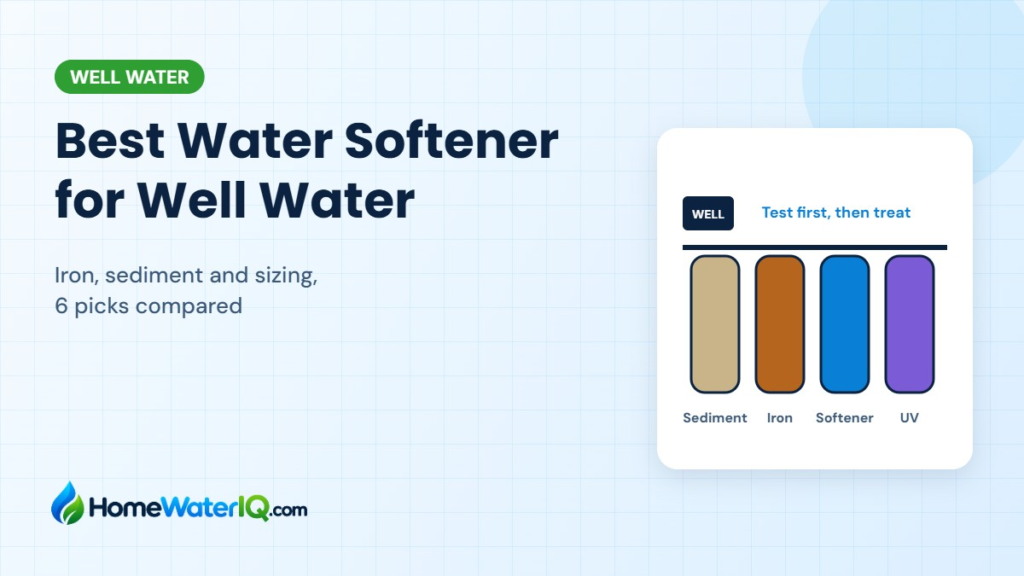
What to install before the softener
A typical order after the pressure tank:
- Sediment filter (spin-down or cartridge) for sand and silt.
- Acid neutralizer if pH is below about 6.5.
- Iron filter if clear-water iron is above about 3 to 5 ppm, or if you have ferric iron, iron bacteria, high manganese or hydrogen sulfide.
- Water softener.
- UV system if bacteria are a concern, last so it sees clear water.
For iron filters, UV and acid neutralizers we recommend, see our best water filter for well water guide.
How to choose a water softener for well water
- Compare iron ratings, not marketing. Look for a published clear-water iron limit well above your level.
- Check flow against your well. Softeners need a minimum supply flow (Morton lists 3 gpm), and backwashing filters need more.
- Think about your septic system. EPA’s WaterSense guide says septic owners should check with their system’s manufacturer or a service provider before adding a softener.
- Prefer certification where you can get it. NSF/ANSI 44 covers softener performance and salt efficiency. Among our picks, the Whirlpool and Morton home-center units have it.
- Skip salt-free conditioners on iron. Most require essentially zero iron and manganese. See best salt-free water softeners for their limits.
Prefer a local installer? Dealer brands such as Kinetico (whose S150 XP also handles soluble iron) cost more; see our Kinetico review and water softener cost guide. For city-water picks, see our best water softeners, and for the basics, how a water softener works.
FAQ
What is the best water softener for well water?
For modest clear-water iron, the Whirlpool WHES48: NSF certified, rated for 12 ppm iron and under $1,000. With more iron or sulfur, a combo such as SpringWell’s or the US Water Systems Flexx.
Can a water softener remove iron from well water?
Yes, if the iron is dissolved (ferrous) and the level is modest. Penn State Extension says softeners work for iron under 5 mg/L with pH above 6.7. Softeners don’t remove rusty (ferric) iron, iron bacteria or organically bound iron, which need an iron filter first.
How much iron is too much for a water softener?
Manufacturer ratings run up to 12 ppm of clear-water iron, but extension guidance and Wisconsin’s rule point to about 5 ppm as a practical limit. We’d add an iron filter above about 3 to 5 ppm.
How do I account for iron when sizing a softener?
Add about 4 to 5 gpg to your hardness for every ppm of clear-water iron, then size as usual. With 15 gpg and 2 ppm iron, use 25 gpg. Our size calculator does it for you.
Will a water softener get rid of the rotten-egg smell?
No. Hydrogen sulfide needs an air-injection or chemical-injection filter ahead of the softener. If the smell is only in hot water, check the water heater’s anode rod first.
Sources: Whirlpool WHES48 manual; Farm & Fleet, Whirlpool WHES48; RC Willey, Whirlpool WHES48; Morton, MSD45E manual; Morton M45C manual, specifications; FrontDeskReview, Morton M45C price; Walmart, AFWFilters Iron Pro 48k; Quality Water Lab, Iron Pro 2 review; Affordable Water, Fleck 5600SXT 48,000; SpringWell, well water systems; SpringWell, well water filter and softener combo; US Water Systems, Flexx combo; US Water Systems, Matrixx Ultimate combo; US Water Systems, Matrixx softener; Penn State Extension, iron and manganese in private water systems; University of Nebraska Extension, drinking water treatment: water softening; NDSU Extension, water softening (ion exchange); EPA WaterSense, water softener guide.
Keep reading
 Best Water Filter for Well Water in 2026 (Matched to Your Test)
Well water problems vary from house to house, so the right filter starts with a lab test. We matched iron,…
 Clearly Filtered Review (2026): Pitcher, Bottle and Under-Sink
Clearly Filtered claims to reduce 386+ contaminants, including fluoride, but only chlorine, taste and odor are certified. Here's what you…
 AquaTru Review (2026): Countertop RO by the Numbers
AquaTru makes some of the best-certified countertop reverse osmosis purifiers you can buy. Here's what each model costs to run,…